
A child spots a squirrel darting across a telephone wire and asks, “Where does it live?”
It would be easy to point toward a nearby oak tree and call it a day. But a habitat is much more than an animal’s address.
When we explore animal habitats for kids, we are really helping children understand how an animal’s life connects with the environment around it.
The squirrel isn’t simply staying in a tree. That tree and the surrounding area provide resources the squirrel needs. It may find acorns and other food nearby, use branches to escape danger, find water in the surrounding environment, and build a nest where it can rest and raise young.
Without the resources it needs, simply having a tree nearby would not be enough.
That gives us a more interesting question to ask when children discover an animal.
Instead of stopping with “Where does it live?” try asking:
“How does this place help the animal live?”
Is there water nearby?
What might the animal eat?
Where could it find shelter?
Where could it hide from danger?
What other living things share this environment?
Those questions turn a passing animal sighting into an investigation. Children begin seeing nature not as a collection of separate animals and plants, but as a network of relationships.
Once they start looking for those connections, even an ordinary backyard or neighborhood park can become a place worth investigating.
What Exactly Is a Habitat?
A habitat is the environment where an animal finds the conditions and resources it needs to live.
For young children, it can help to think about some basic needs:
- Food
- Water
- Shelter
- Space
- Suitable environmental conditions
Return to our squirrel.
The tree may provide shelter, nesting space, and a way to escape some predators. Nearby plants may provide seeds, nuts, fruits, or other food. Water may come from puddles, streams, ponds, or other sources in the surrounding area.
All of those pieces contribute to the environment in which the squirrel lives.
Different animals need different combinations of resources and conditions.
A fish needs an aquatic environment. A squirrel does not.
An animal living in a very cold environment faces different conditions from one living in a tropical rainforest.
This is where habitat exploration becomes much more interesting than simply memorizing where animals live.
Children can begin asking why particular animals are found in particular places.
Animal Habitats for Kids: Exploring Different Environments
Children do not need to memorize dozens of habitat categories.
Instead, compare a few dramatically different environments and ask what challenges an animal living there might face.
Consider a tropical rainforest.
It is generally warm and receives abundant rainfall. Vegetation can be dense, and animals may live at very different levels, from the forest floor to high in the canopy.
Now compare that with an Arctic environment.
Temperatures can be extremely cold, vegetation is much more limited, and animals face challenges associated with snow, ice, wind, and seasonal changes in available food.
An ocean presents an entirely different set of conditions. Animals living there must function in water rather than on land.
A grassland or savannah provides large open spaces and different forms of vegetation and shelter.
A desert introduces challenges involving heat, limited rainfall, and access to water.
The useful question is not simply:
“What animals live here?”
Go one step further:
“What is it about this environment that affects how animals live here?”
That question encourages children to connect the animal with its surroundings.
Look at the Animal for Habitat Clues
An animal’s physical features can provide clues worth investigating.
Consider feet.
A duck’s webbed feet and a squirrel’s clawed feet look very different. Rather than simply telling a child what each feature does, ask what they notice.
“How are these feet different?”
“Where does each animal spend its time?”
“How might those feet be useful there?”
Look at fur, feathers, body shape, coloration, claws, tails, ears, and beaks in the same way.
A child might notice the thick fur of an animal living in a cold environment. Another animal may have coloring that makes it difficult to see against its surroundings. A bird’s beak may offer clues about the kinds of foods it can eat.
These relationships can be complex, so there is no need to reduce every feature to one simple explanation.
Instead, use observable differences as starting points for questions.
What do you notice?
How might that be useful?
What else would we need to know?
Now children are investigating rather than simply memorizing facts.
Ask Questions That Connect Animals With Their Habitats
One of the easiest ways to explore habitats is to keep a few good questions available whenever children encounter an animal.
Try:
What do you think this animal eats?
Then continue:
Where might it find water?
Where could it sleep or find shelter?
How does it move through this environment?
What features might help it live here?
What kind of weather does it experience?
What other animals might share this habitat?
What plants are growing here?
What might change during another season?
What could happen if an important part of this habitat disappeared?
The goal is not for children to immediately produce the correct answer to every question.
A child might make a reasonable guess that turns out to be incorrect. That gives you something to investigate together.
The questions matter because they encourage children to look beyond the animal itself.
A bird becomes connected to the tree where it shelters, the insects it eats, the water it drinks, the weather it experiences, and the other animals sharing its surroundings.
That is a much richer understanding than simply knowing the bird’s name.
Go Beyond Animal-and-Habitat Matching
Matching activities can provide a useful introduction to habitats.
A child matches a polar bear with an Arctic scene.
A camel goes with a desert.
A frog goes with a pond or wetland.
That establishes a basic relationship, but it can also become the beginning rather than the end of the activity.
Once the match is made, ask:
“What about this environment makes it suitable for that animal?”
Now the child has to look more closely.
Compare two habitats.
How is an Arctic environment different from a rainforest?
How is an ocean different from a grassland?
What resources are available in one that may not be available in another?
Then compare animals.
How do the animals move differently?
Where do they find shelter?
What do they eat?
How might their bodies help them function in their environments?
Comparison encourages children to move beyond remembering a fact and begin thinking about relationships.
Habitats Are Full of Connections
Animals do not live independently from everything around them.
They need resources.
Plants can provide food and shelter. Water sources support many forms of life. Animals may eat plants or other animals. Multiple species may depend on some of the same resources.
A pond provides an easy example.
Plants grow in and around the water.
Insects may live among those plants.
Frogs may eat insects.
Birds and other animals may visit the pond to drink, feed, rest, or hunt.
Children do not need an advanced lesson about food webs to recognize that these living things are connected.
Ask:
“What might happen if there were no insects here?”
“What animals might use these plants for shelter?”
“Who might visit this water?”
“What else depends on this pond?”
The purpose is not to teach every ecological relationship. It is to help children recognize that a habitat is a system containing many interacting parts.
Explore Habitats Close to Home
You do not need a safari, rainforest expedition, or Arctic adventure to investigate habitats.
Some of the most useful observations can happen close to home.
Choose one tree and investigate it.
Look at the trunk, branches, leaves, roots, and ground underneath.
What animals can you find?
Are there birds in the branches?
Ants on the bark?
Insects underneath leaves?
Spider webs between branches?
Holes that might provide shelter?
Seeds, nuts, flowers, or fruit that could provide food?
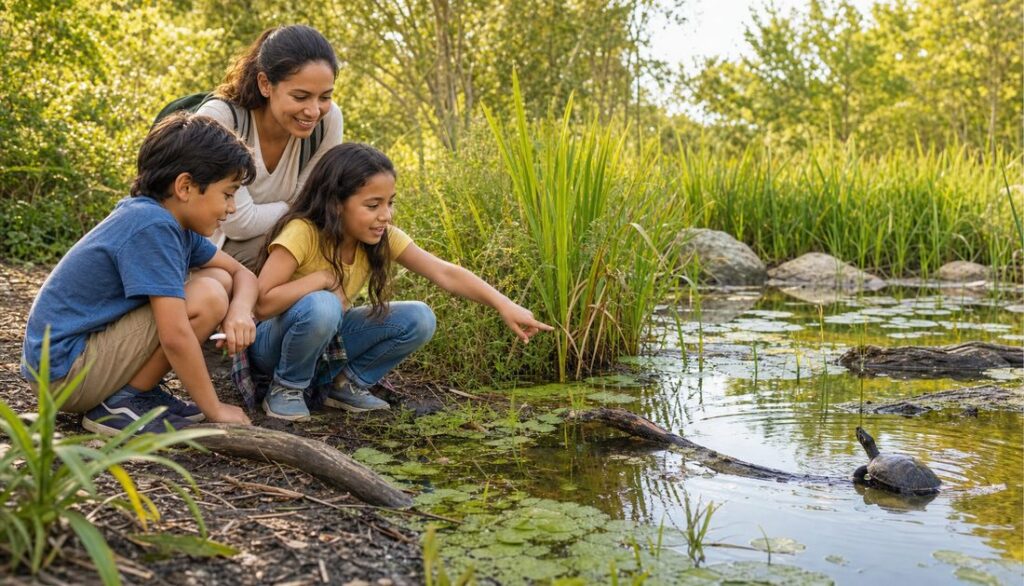
Try the same investigation with a patch of grass, garden, group of shrubs, pond edge, creek, or fallen log.
Even a small area can provide resources for multiple living things.
Children can draw what they find, make lists, compare locations, count animals, record questions, or simply talk about their observations.
The important part is learning to investigate the environment rather than assuming interesting habitats exist only somewhere far away.
Clear Up a Few Common Habitat Misconceptions
Children may begin with some understandable misconceptions about wildlife and habitats.
One is that wild animals live mainly in distant forests, jungles, oceans, or other exotic places.
But the bird on the lawn, spider near the porch, rabbit in the park, and insect underneath a leaf are wild animals too.
Another misconception is that a habitat belongs to one particular animal.
A tree does not exist as a habitat for only a squirrel. Birds, insects, spiders, and many other organisms may use that same tree in different ways.
Children may also assume that animals can simply move somewhere else if their habitat changes.
Sometimes animals can relocate. But finding another suitable place is not always simple. Animals need environments containing the particular resources and conditions they depend on.
This provides a gentle introduction to why habitat protection matters.
Protecting wildlife is not only about protecting individual animals. It also involves caring for the places and resources those animals need.
That idea is enough for young learners. Conservation can be explored more deeply as their understanding grows.
Turn an Ordinary Walk Into a Habitat Investigation
The next time you take a walk, choose one small area and investigate it as a habitat.
It could be a tree, pond edge, patch of grass, garden, fallen log, or cluster of shrubs.
Then ask:
What lives here?
Where is the water?
What food might be available?
Where could a small animal hide?
What provides shelter?
What sounds can we hear?
What evidence shows that animals have been here?
What would be different if we came back at another time of day?
You do not need a worksheet or formal lesson.
Look.
Compare.
Ask questions.
Make guesses.
Return another day.
Children may discover that the same place looks different after rain, during another season, or at a different time of day.
That is part of the investigation too.
Children who enjoy investigating animals and the places they live can continue exploring with Wildlife Explorer! Animal & Habitat Activity Workbook for Kids. Designed for Grades 1–3, it introduces young learners to animals, habitats, footprints, food relationships, observation, puzzles, and age-appropriate conservation concepts through hands-on activities.
From “Where Does It Live?” to “How Does It Live Here?”
Learning about animal habitats can begin with simple facts.
A polar bear lives in the Arctic.
A frog may live around a pond or wetland.
A fish lives in water.
But the more interesting learning begins with the next question.
Why does that environment work for that animal?
Now children have something to investigate.
They can think about food, water, shelter, climate, physical features, behavior, plants, other animals, and the many relationships that make life possible in a particular place.
That changes the way children look at animals.
It can also change the way they look at an ordinary backyard, tree, pond, or neighborhood park.
Instead of seeing a place with a few animals in it, they begin seeing resources, relationships, clues, and questions.
So the next time a child asks, “Where does that animal live?” answer the question.
Then ask one more:
“How does this place help the animal live?”