
Most people associate inventing with a flash of genius or a brilliant idea that appears out of nowhere.
For children, it can begin with something much more ordinary: a small problem.
Maybe a pencil keeps rolling off the desk. Art supplies become a jumble inside a backpack. A book will not stay open while they are trying to use both hands for something else.
These little frustrations can be excellent starting points for invention activities for kids.
The goal is not to dream up a revolutionary machine. It is to notice something that could work better and ask a simple question:
“Could I make this work better?”
That question changes the activity.
Instead of simply accepting how something works, children begin examining it. They notice problems, consider alternatives, and think about possible improvements.
They also do not need expensive STEM kits, electronics, specialized tools, or complicated equipment to begin.
Paper, cardboard, tape, string, craft sticks, recycled containers, building blocks, and other simple materials can provide plenty of possibilities.
In fact, limited materials can introduce another interesting challenge: What can I create with what I already have?
The first step is simply learning to notice problems worth investigating.
From Problem to Invention: A Simple Process
Once a child identifies a problem, the next question is usually:
“What do I do now?”
A simple invention process can provide enough structure to keep the project moving without turning it into a rigid assignment.
1. Notice a Problem
Start with something that is inconvenient, difficult, repetitive, messy, or simply not working as well as the child would like.
2. Define What Needs to Change
What exactly is the problem?
“Pencils are annoying” is broad.
“My pencil keeps rolling off my slanted desk” gives the young inventor something specific to investigate.
3. Brainstorm Several Possibilities
Encourage children to think beyond their first solution.
What are three ways this problem might be solved?
Some ideas may seem impractical or silly. Write them down anyway. Brainstorming is about generating possibilities before deciding which one deserves further attention.
4. Choose an Idea
Now compare the possibilities.
Which idea seems most promising?
Which one can be tested with the materials available?
Which one does the child most want to try?
5. Sketch the Idea
The drawing does not need to be artistic.
A rough sketch can help the child think about shape, size, parts, materials, movement, and how everything might fit together.
6. Build a Prototype
A prototype is simply an early version created to test an idea.
It can be made from cardboard and tape. It can look rough. It may not work.
That is exactly what prototypes are for.
7. Test It
Try the invention.
Watch what happens.
Does it solve the original problem?
Where does it struggle?
8. Improve and Test Again
Use what happened during testing to decide what to change.
Then try again.
Children may move backward and forward through these steps, and that is perfectly reasonable. Someone may build first and realize they need a better sketch. Another child may test an idea and return to brainstorming.
The process is a guide, not a checklist.
Finding Everyday Problems Worth Solving
One reason children sometimes struggle with inventing is that adults begin with a question that is simply too large:
“What do you want to invent?”
That can make it seem as though children need an extraordinary idea before they can begin.
Shrink the challenge.
Ask:
“What is something that bothered you today?”
“What was harder to do than it should have been?”
“What keeps getting messy?”
“What do you have to do over and over?”
“What do you wish worked differently?”
Suddenly, potential invention problems are everywhere.
Perhaps several small objects are difficult to carry at once.
Maybe art supplies are difficult to organize.
A favorite book will not stay open.
Something frequently falls over.
A storage space is awkward to use.
A repetitive household task feels unnecessarily complicated.
Do not immediately propose solutions.
If a child complains that pencils keep rolling off the desk, resist the temptation to say, “You could make a pencil holder.”
Instead ask:
“Why do you think they keep rolling?”
“What would have to change to stop that?”
“Could there be more than one way to solve it?”
Now the child owns the problem and the possible solutions.
Why Brainstorming More Than One Idea Matters
Children can become attached to the first solution they think of.
Adults do this too.
The first idea may ultimately be the best one, but generating alternatives helps children discover that a problem can often be approached in several ways.
Suppose a child wants to carry several small objects without dropping them.
Instead of immediately building the first container they imagine, ask them to sketch three possibilities.
Could something hold the objects?
Could something attach them together?
Could the way they are carried change?
Could the objects themselves be organized differently?
There is no need to evaluate every idea immediately.
First, generate possibilities.
Then compare them.
Which idea looks easiest to build?
Which requires materials you already have?
Which might solve the problem most effectively?
Which one would be easiest to test?
This introduces an important idea: creative problem solving is not always about finding the answer.
Sometimes it is about generating possibilities and deciding which one is worth trying.
Sketch Before You Build
Once a child chooses an idea, encourage a quick sketch.
This is not an art assignment.
Stick figures, boxes, arrows, circles, labels, and rough shapes are perfectly adequate.
The purpose is thinking.
Where will the parts go?
How large should it be?
What needs to move?
What needs to stay still?
How will two pieces connect?
What material might work for each part?
A child may discover during sketching that something they imagined cannot fit together the way they expected.
Excellent.
They have identified a design problem before using any materials.
A sketch also creates something useful to compare with the prototype later.
Did the finished version work the way the child expected?
What changed between the drawing and the object?
Why?
Those differences can become part of the investigation.
Prototypes Make Invention Activities for Kids More Interesting
The word prototype can sound technical, but the concept is simple.
A prototype is an early version of an idea that lets you test how it might work.
It does not need to be polished.
It does not need decorations.
It does not need to last forever.
And it definitely does not need to work perfectly.
Suppose a child wants to invent something that moves an object from one side of a table to another.
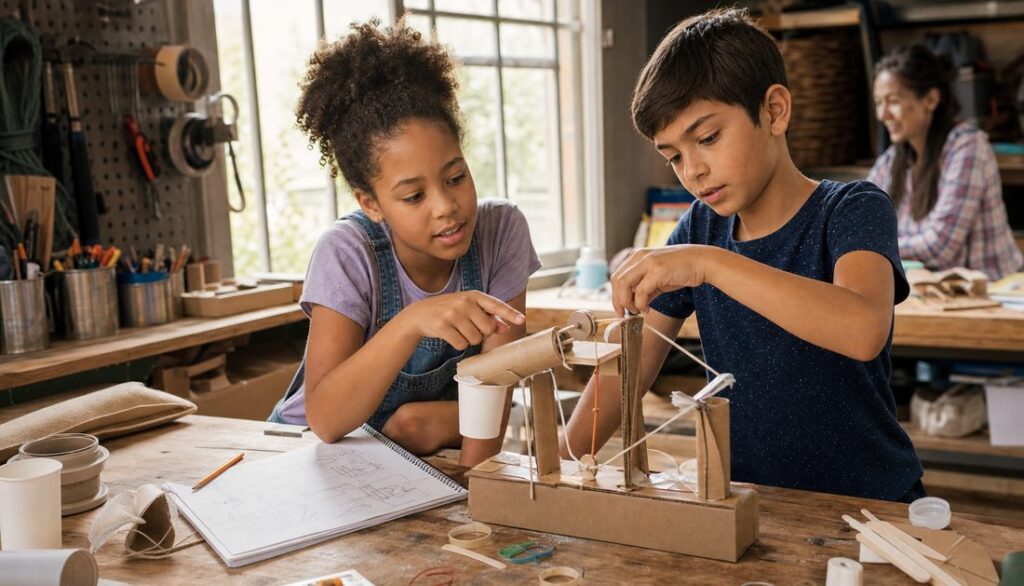
The first prototype might be made from a cardboard tube, string, tape, and a paper cup.
It may collapse immediately.
That does not mean the invention failed.
It means the prototype revealed something.
Perhaps the cardboard was not strong enough.
Maybe the string was attached in the wrong place.
Perhaps the object was too heavy.
Maybe the entire mechanism was more complicated than necessary.
Every one of those discoveries gives the child information for the next version.
Testing Is Where Ideas Meet Reality
An invention can seem perfect in a child’s imagination and behave very differently when built.
That is why testing matters.
After building a prototype, ask the child to try it under the conditions it was designed for.
Then ask:
What worked?
What did not work?
Where did it break or become difficult to use?
Did it solve the original problem?
What would you change?
Which part should you test again?
Is there a simpler solution?
Testing gives children something concrete to reason about.
Instead of asking, “Is my invention good?” they can ask, “What happened when I tried it?”
That is a much more useful question.
A test that reveals a problem has accomplished something important.
It has shown the inventor what to investigate next.
How Adults Can Help Without Taking Over
There will probably be a moment when the tape will not hold, the cardboard bends, or two parts refuse to work together.
An adult may see the solution immediately.
Try not to take over.
Solving every difficulty for the child can unintentionally remove the very thinking that makes the activity valuable.
Instead, ask questions that return the problem to the inventor.
“What are you trying to make happen?”
“What part is giving you trouble?”
“What else could you try?”
“What could you change without rebuilding everything?”
“How will you know whether your idea worked?”
If the child genuinely needs assistance, provide enough help to move past the obstacle without redesigning the invention yourself.
There is an important difference between helping a child safely cut a difficult piece of cardboard and deciding what shape that piece should be.
The invention should continue to belong to the child.
Creativity and Practical Thinking Belong Together
Inventing combines imagination with practical constraints.
A child can dream up an extraordinary idea, but eventually the prototype has to do something.
Does it move?
Does it hold the object?
Does it stay upright?
Does it solve the problem?
At the same time, a practical solution does not need to be dull.
Children can experiment with shapes, materials, mechanisms, arrangements, and unexpected combinations.
That interaction between “What could I create?” and “Will it actually work?” is one of the most interesting parts of invention.
The two questions belong together.
Adjust the Challenge as Children Grow
Invention activities can change as children develop.
Younger children may do much of their inventing through drawing, building, pretend play, and experimenting with materials.
A cardboard box can become a machine. Tubes can become ramps. Blocks can become supports.
Let them build and explain what they created.
Older children may be ready to approach invention more deliberately.
They can think about:
- Measurements
- Material choices
- Moving parts
- Strength and stability
- User needs
- Design constraints
- Multiple possible solutions
- Repeated testing
They can also begin changing one variable at a time.
If a prototype collapses, for example, they might change the support structure while leaving everything else alone. Then they can see whether that particular modification helped.
The invention process becomes more sophisticated without losing the experimentation that made it interesting in the first place.
When a Child Says, “I Can’t Think of Anything to Invent”
Do not ask for a bigger idea.
Make the problem smaller.
Instead of:
“What could you invent?”
try:
“What is one thing that annoyed you today?”
Or:
“What is something you wish were easier?”
“What keeps falling over?”
“What gets lost?”
“What takes too many trips to carry?”
“What is difficult to organize?”
“What do you have to keep fixing?”
“What could work better?”
Children may discover that invention ideas were around them all along.
They simply were not looking at everyday frustrations as problems they were allowed to investigate.
The Prototype Does Not Have to Become a Product
A child may finish an invention project with something made from cardboard, tape, string, and three bottle caps.
That is enough.
The prototype does not have to become a permanent object.
It does not need to be patented.
It does not need to be sold.
It does not need to win a competition.
It does not even need to work particularly well.
The child noticed a problem.
They generated ideas.
They made decisions.
They created a plan.
They built something.
They tested it.
They discovered problems.
They made changes.
That process has value even when the finished object eventually ends up in the recycling bin.
Ready to Put an Invention Idea to Work?
Children who are ready to develop their own ideas can continue exploring with Invent It! Young Inventor Workbook for Kids. It guides young inventors through identifying problems, developing ideas, planning designs, and thinking creatively about how their inventions could work.
Start With One Small Problem
Children do not need extraordinary ideas to begin inventing.
They need something worth noticing.
A pencil rolls away.
A container is difficult to use.
Something takes too many trips to carry.
A simple task feels unnecessarily awkward.
Those ordinary moments can become invitations to investigate.
The next time a child complains that something does not work very well, resist the urge to immediately fix it.
Instead, try asking:
“What could you try?”
That small question may be all the invitation a young inventor needs.