
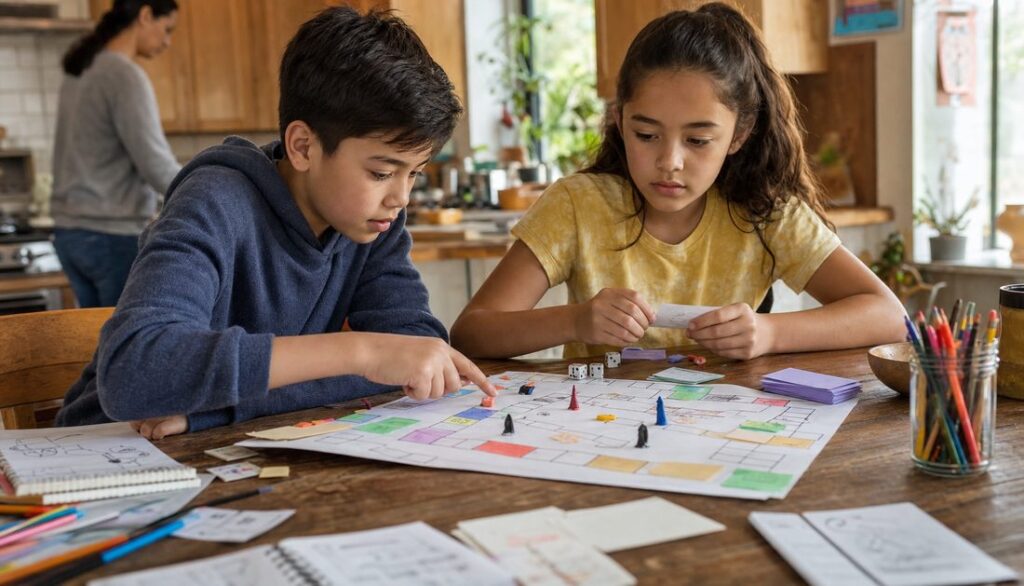
Playing a game and making a game might sound like the same activity, but they ask children to do very different kinds of thinking.
When children play a game, they follow a path someone else created. When they design one, they have to build that path themselves, decide where it goes, and figure out what happens when something does not work as expected.
That shift is what makes game design for kids such an interesting creative learning activity.
Instead of simply rolling dice and moving pieces, children become responsible for deciding how many spaces players can move, what happens when someone lands on a particular space, how points are earned, or what a player needs to accomplish to win.
Every decision introduces another problem to solve.
What is the goal?
What are the rules?
How do players make choices?
Is the game too easy or too difficult?
Can everyone understand how to play?
What happens when a rule creates a problem the designer did not anticipate?
These are creative questions, but they also require planning, reasoning, decision-making, and problem solving.
Children do not need to be told that they are practicing these skills. Give them the opportunity to create a game, and the problems appear naturally.
A rule that sounded perfectly clear to the designer may confuse another player. A game intended to last ten minutes may take an hour. Someone may discover a shortcut that makes winning too easy.
Each of those moments provides information.
The challenge becomes figuring out what to change.
The Problems Hiding Inside Every Game
The moment a child decides to create a game, questions begin appearing.
What is the point of the game?
How do you win?
How many people can play?
What can a player do during a turn?
Suppose a child decides the goal is to reach the end of a game board.
That sounds simple enough.
But how will players move? Will they roll dice, draw cards, answer questions, or make choices?
What happens when someone lands on a special space?
Can players move backward?
Can one player affect another player?
What happens if two players reach the finish at the same time?
Each answer can create another question.
That is one reason game creation can become such an engaging problem-solving activity. Children are solving problems connected to something they are building themselves.
A child designing a game about escaping from a dragon’s cave may become highly invested in deciding whether the dragon catches players too easily. Someone creating a treasure-hunting game may discover that collecting treasure is so easy that there is no challenge.
Adults can help without supplying the solutions.
Try asking:
“What happens if two players reach that space at the same time?”
“Is there a reason someone would choose this path instead of that one?”
“What happens if a player runs out of cards?”
Questions like these help children notice gaps in their designs while leaving the decisions in their hands.
Rules Are Problems to Solve Too
Writing rules introduces another challenge.
Children know how their own game is supposed to work. Because the rules make sense in their heads, they may not realize how much information another player is missing.
Then someone else tries to play.
Suddenly, the designer hears questions.
“Am I allowed to do this?”
“What happens now?”
“Do I get another turn?”
“What does this card mean?”
That confusion can be useful.
A well-designed game needs rules that other people can understand, which means children have to think beyond what they intended and consider what they actually communicated.
Suppose a rule says, “Players take turns moving.”
That may seem clear until someone lands on a space that says “Go Back.”
Does moving backward end the turn?
What happens if two players occupy the same space?
Can a player become stuck?
What happens when someone reaches the final space with a number larger than they need?
Children begin discovering that rules need clarity.
They may also begin thinking about fairness.
Perhaps the player who goes first has such a large advantage that everyone else struggles to catch up. Maybe one card is so powerful that whoever draws it almost always wins.
When players become confused or discover an unfair advantage, the game has provided its designer with a new problem to investigate.
The solution might be rewriting a rule, adding an exception, changing a card, or removing something entirely.
Precision stops being an abstract idea. It becomes necessary because the game will not work properly without it.
Play-Testing Is Where Game Design Gets Interesting
The first version of a homemade game probably will not work perfectly.
That is not a problem.
It is part of designing.
Children can spend considerable time planning a game and still discover something unexpected as soon as another person begins playing it.
Perhaps the game ends almost immediately.
Maybe it never seems to end.
One player gets an enormous advantage.
A rule nobody questioned during planning becomes confusing.
Players repeatedly choose the same option because the other choices do not matter.
Someone gets stuck with no way to continue.
None of those outcomes means the project failed.
They tell the designer something about how the game actually works.
A simple play-testing process can look like this:
- Build a basic version.
- Play it using the rules as written.
- Notice where players become confused.
- Look for parts that are too easy or too difficult.
- Identify rules or choices that do not work as expected.
- Change one thing.
- Play again.
There is no need to make the first version beautiful.
Paper can become a game board. Index cards can become playing cards. Coins, buttons, blocks, or other small household objects can become game pieces.
The goal of the first version is to discover whether the idea works.
Ask Questions Instead of Fixing the Game
Adults can play an important role during testing, but it is easy to accidentally take over.
If you immediately identify every problem and propose the solution, the child becomes responsible for following your design rather than developing their own.
Questions can be much more useful.
Try:
“Was that move too powerful?”
“Which rule did we have to explain more than once?”
“Could a player get stuck here?”
“What happened when we tried that rule?”
“How could you make that fair for both players?”
“What could you change?”
“What do you think would happen if we tried it another way?”
The goal is not to make children struggle unnecessarily. It is to give them enough room to recognize problems and experiment with possible solutions.
Sometimes they will choose a solution you would not have chosen.
Let them test it.
If it works, they discovered something.
If it does not work, they discovered something then too.
Revision Is a Normal Part of Game Design for Kids
A play-test may end with a child discovering that a favorite idea simply does not work.
That can be frustrating.
The game may be boring. A rule may make no sense. A carefully designed board may need to change. A card the child loves may make winning far too easy.
This is where revision becomes important.
Changing the game is not evidence that the original idea failed. It is what designers do when testing reveals something they could not see during planning.
A game that is too easy provides information.
A game that takes too long provides information.
A rule nobody understands provides information.
A player who gets stuck provides information.
Instead of immediately fixing the problem, help the child interpret what happened.
“What happened when we tried that?”
“What part would you change first?”
“Why do you think everyone kept choosing that card?”
“What could make this part more challenging?”
Changing the scoring system, redrawing part of the board, rewriting instructions, removing a rule, or adding a new choice is not starting over.
It is improving the design.
A Simple Game Design Process Kids Can Follow
A blank sheet of paper can feel overwhelming, especially when a child thinks the finished game needs to be complicated.
It does not.
A simple process can provide enough structure to begin.
1. Choose an Idea or Theme
Start with something the child finds interesting.
It could involve space exploration, dinosaurs, sports, animals, treasure hunting, mysteries, monsters, racing, cooking, or almost anything else.
2. Decide the Goal
What does a player need to accomplish?
Reach the finish?
Collect something?
Solve a mystery?
Earn the most points?
Complete a challenge?
A clear goal gives the rest of the game a direction.
3. Decide What Players Can Do
Keep the first version simple.
Players might roll a die, move a token, draw a card, answer a question, collect an object, make a choice, or trade something.
One or two basic actions may be enough.
4. Create a Few Rules
Begin with the rules necessary to make the game playable.
More rules can be added later if testing shows they are needed.
5. Build a Simple First Version
Use whatever materials are available.
Paper, pencils, index cards, dice, coins, buttons, blocks, sticky notes, and markers can be enough to create a working prototype.
6. Play-Test It
Do not wait until every illustration is finished.
Try the game.
7. Notice What Works and What Does Not
Where did players become confused?
Was something too easy?
Did the game take too long?
Was one choice much better than all the others?
Did everyone understand the rules?
8. Change Something and Test Again
Choose one problem and make an adjustment.
Then see what happens.
That cycle of creating, testing, noticing, and revising is at the heart of the activity.
Creativity and Problem Solving Work Together
The creative parts of designing a game are not separate from the problem-solving parts.
They often support each other.
A child who becomes excited about creating a space adventure may be more willing to wrestle with a movement rule that is not working.
Characters can create ideas for special abilities.
A treasure-hunting theme can inspire decisions about rewards and risks.
A mysterious castle might suggest secret passages, obstacles, or surprise cards.
Artwork, stories, characters, boards, cards, challenges, and themes give children reasons to care about making the underlying game work.
That is why the activity can appeal to children with very different interests.
One child may spend most of the time drawing the board.
Another may become fascinated by rules.
Someone else may enjoy testing strategies.
All of them are contributing to the same design problem.
Game Design Can Grow With the Child
The complexity of the activity can change with age and experience.
Younger children might create a simple path game using colors, matching, cards, or dice. The goal may be nothing more complicated than reaching the final space.
That is enough.
Older children may begin experimenting with scoring systems, strategy, resources, probability, player choices, multiple paths, or rules that interact with one another.
There is no need to rush toward complexity.
A simple game that a child can actually build, test, and revise provides more opportunity for meaningful problem solving than an elaborate idea that never gets beyond the planning stage.
A Game Does Not Need to Be Perfect to Be Worth Creating
A homemade game does not have to become something polished enough to sell, share widely, or keep forever.
It does not even have to become a particularly good game.
The process itself can be worthwhile.
A child started with an idea.
They made decisions.
They turned those decisions into rules.
Someone tested those rules.
Problems appeared.
The child figured out what to change.
Then they tried again.
That is a very different experience from simply following instructions someone else created.
When children become game designers, they discover that problems are not always obstacles that stop a project.
Sometimes problems are information.
A confusing rule tells you something.
An unfair advantage tells you something.
A game that ends too quickly tells you something.
The question becomes:
What should I try next?
And that is where game design becomes much more than simply playing a game.