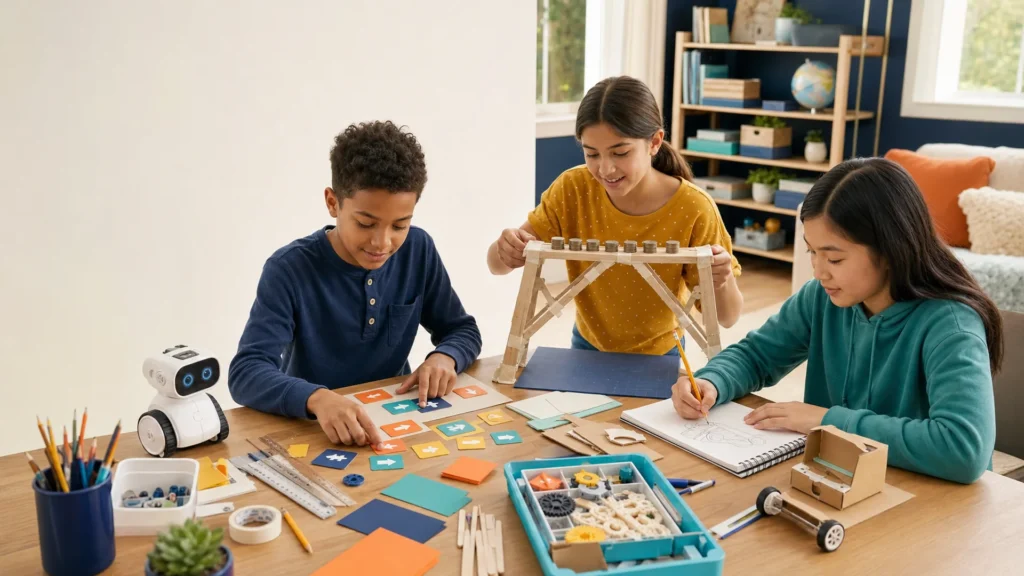
Some families hear the word STEM and picture laboratories, complicated equipment, expensive kits, or advanced computer programs. In reality, many valuable STEM activities for kids at home begin with paper, tape, recycled materials, pencils, and a willingness to experiment.
STEM learning is not limited to memorizing scientific facts or completing math problems. It also teaches children how to observe, plan, test ideas, recognize mistakes, and improve a solution.
These abilities are useful far beyond science and technology. Children use them when organizing schoolwork, solving everyday problems, explaining their reasoning, and recovering when an idea does not work as expected.
Why STEM Activities for Kids at Home Matter
Hands-on STEM exploration gives children an opportunity to make decisions and observe the results.
A child building a paper bridge must consider shape, strength, balance, and weight. A learner writing instructions for a robot must think carefully about sequence and clarity. A young inventor must identify a problem before developing a useful solution.
Although the projects may look different, they develop many of the same abilities:
- Logical thinking
- Creative problem-solving
- Planning and organization
- Careful observation
- Communication
- Persistence
- Reflection and improvement
Parents and educators do not need to provide every answer. In fact, children often learn more when adults ask thoughtful questions and give them time to develop their own solutions.
Questions such as “What happened?”, “Why do you think that worked?”, and “What could you change?” encourage learners to examine their decisions instead of waiting for an adult to fix the problem.
Begin With Screen-Free Coding
Coding is often associated with computers, but the thinking behind coding can be introduced without a screen.
Programmers organize instructions, recognize patterns, test sequences, find errors, and revise their work. Children can practice those same skills with arrows, symbols, puzzles, mazes, cards, and everyday routines.
An algorithm is simply an ordered set of instructions created to complete a task. A recipe is an algorithm. Directions for getting ready in the morning are also an algorithm.
Ask a child to explain every step required to make a sandwich. If a direction is missing or placed in the wrong order, the result may not match the original plan. This simple exercise demonstrates why coding instructions must be clear, complete, and correctly sequenced.
Other screen-free coding activities include:
- Following arrows through a maze
- Completing visual patterns
- Arranging task cards in the correct order
- Decoding a simple secret message
- Identifying an incorrect instruction
- Creating if-then rules
- Finding repeated steps that could form a loop
Think Like a Coder! Coding & Logic Workbook for Kids provides structured practice with algorithms, sequencing, patterns, binary code, conditional logic, loops, and debugging. The activities help learners understand how coders think before they begin working with a particular programming language.
Families looking for additional activities can explore the free computer science and coding resources available through CodeAI.
Turn Ideas Into Engineering Challenges
Engineering gives children a physical way to apply planning, testing, and problem-solving.
The engineering design process generally asks learners to:
- Understand the challenge
- Imagine possible solutions
- Create a plan
- Build a model
- Test the design
- Evaluate the result
- Make improvements
Children often want to move directly from an idea to building. That enthusiasm is valuable, but the greatest learning frequently happens after the first test.
A tower may fall because its base is too narrow. A bridge may bend because the paper needs to be folded differently. A boat may tip because its weight is unevenly distributed.
These outcomes are not failures. They provide useful information about the design.
Simple engineering challenges can involve building:
- A paper bridge that supports coins
- A tower using cups or index cards
- A foil boat that carries weight
- A paper airplane designed for distance
- A balloon-powered vehicle
- A protective container for an egg
- A parachute that falls slowly
Build It! Engineering Challenge Workbook for Kids guides learners through hands-on projects involving towers, bridges, boats, vehicles, aircraft, simple machines, robots, and original inventions. Planning and reflection prompts encourage children to think about why a design worked and how it could be improved.
Help Children Think Like Inventors
Engineering often begins with a defined challenge. Invention begins with noticing a problem worth solving.
Children encounter small frustrations every day. A backpack may be difficult to organize. Art supplies may roll off a table. A younger sibling may need help remembering a routine.
These observations can become starting points for invention.
Encourage learners to ask:
- What problem do I notice?
- Who experiences this problem?
- Why does it matter?
- What solutions already exist?
- How could I make one of those solutions better?
- What new idea could I test?
The first idea does not need to be perfect. Brainstorming works best when children are allowed to generate several possibilities before judging them.
After choosing an idea, a learner can sketch it, build a simple prototype, test it, collect feedback, and make changes.
Invent It! Young Inventor Workbook for Kids helps children move from identifying a need to developing and improving a possible solution. It connects creativity with planning, communication, empathy, and practical problem-solving.
Let Children Learn From Imperfect Results
Adults naturally want to prevent frustration, especially when they can see an obvious solution. However, stepping in too quickly can remove the most valuable part of the experience.
Instead of correcting a child’s design, ask questions that encourage further thinking:
- What did you expect to happen?
- What actually happened?
- Which part worked best?
- Where did the problem begin?
- What is one change you could test?
- How will you know whether the change helped?
This approach teaches children that mistakes can be examined and used.
Coding calls this process debugging. Engineering calls it testing and redesign. Inventors call it improving a prototype. The language changes, but the habit remains the same.
Choose the Best Starting Point
Children do not need to explore every STEM subject at once.
These STEM activities for kids provide practical ways to connect creativity, technology, engineering, and problem-solving.
A learner who enjoys puzzles and patterns may begin with Think Like a Coder! A child who enjoys building may prefer Build It! A learner who frequently sketches new products or notices everyday problems may connect with Invent It!
The most effective starting point is often the activity that already matches the child’s curiosity.
STEM activities for kids at home should create room for questions, experimentation, and discovery. With manageable materials and thoughtful encouragement, children can learn to plan carefully, test confidently, and view improvement as a natural part of solving problems.
Explore the Technology & Future Skills workbook collection at EncouragingLearningCo.com.