A child can answer a basic calculation correctly and still struggle when that same skill appears inside a story problem. The difficulty may not be addition, subtraction, multiplication, or division. The real challenge is deciding what the problem is asking, which information matters, and where to begin.
Math mysteries for kids provide an engaging way to practice these deeper thinking skills. Instead of completing isolated calculations, learners follow a story, examine clues, organize information, and use mathematics to reach a logical conclusion.
The goal is not simply to find an answer. Children must also understand why the answer makes sense.
Why Math Mysteries for Kids Matter
Traditional math practice helps children strengthen essential skills and improve accuracy. Story-based mysteries give them opportunities to apply those skills in a meaningful context.
A learner solving a mystery may need to determine which clues are useful, compare several possibilities, complete calculations, and reconsider an earlier conclusion. These actions require more than memorizing a procedure. They encourage children to think carefully about how information fits together.
Because the mathematics contributes to solving a case, learners also have a clear reason to complete each problem. Curiosity helps carry them from one step to the next.
Math mysteries should supplement regular instruction and practice. They do not replace a complete mathematics curriculum. Their value comes from helping children use familiar skills in situations that require reasoning, attention, and persistence.
Reading Carefully and Finding Relevant Information
Many children rush through word problems because they are searching for numbers instead of meaning. A mystery encourages a different approach.
Details about time, quantity, order, location, measurement, or comparison may help eliminate possibilities or reveal the next step. Children must slow down, read carefully, and decide what each clue contributes to the case.
This develops the habit of asking useful questions:
- What information do I already know?
- What am I trying to discover?
- Which details are relevant?
- What mathematical skill could help?
- Does my answer agree with the other clues?
These questions are valuable in mathematics, reading comprehension, science, and everyday decision-making.
Organizing Clues and Applying Math Skills
A mystery usually contains information that must be collected across several pages or stages. Learners may need to record answers, compare results, eliminate possibilities, or place events in the correct order.
That process strengthens organizational thinking. Instead of treating every problem as a separate exercise, children begin to recognize relationships between pieces of information.
The mathematics may involve familiar grade-level skills such as:
- Addition and subtraction
- Multiplication and division
- Place value
- Fractions
- Time and measurement
- Patterns and sequences
- Geometry
- Multi-step word problems
The story gives each calculation a purpose. A learner might calculate a time difference to determine when an event occurred or solve a measurement problem to identify which object matches a clue.
The math remains important, but it becomes part of a larger reasoning process.
Checking Answers and Revising Mistakes
A completed calculation is not necessarily a correct solution. The answer must also fit the evidence presented in the mystery.
When an answer conflicts with another clue, children have a natural reason to review their work. They may discover a calculation error, notice a detail they overlooked, or recognize that they interpreted the question incorrectly.
This makes revision feel like part of solving the case rather than a punishment for getting something wrong.
Children learn that mistakes provide useful information. They can return to the problem, try another approach, and continue working toward a conclusion supported by all the available evidence.
Building Persistence and Confidence
Some learners become discouraged when they cannot solve a problem immediately. Math mysteries for kids can help them see challenging problems as a series of manageable steps.
One clue may lead to another. A calculation may eliminate one possibility without revealing the complete answer. Progress happens gradually.
Each small discovery gives learners a reason to continue. When they finally solve the case, they can see how their reading, calculations, and reasoning worked together.
That experience builds confidence based on genuine accomplishment. The child did not merely guess correctly. The child followed the evidence and earned the solution.
Three Ways to Use Math Mysteries
Parents, homeschool families, and educators can use story-based mysteries without changing their complete learning plan.
amilies who need additional grade-level practice can also explore the free mathematics resources available through Khan Academy.
Weekly Problem-Solving Practice
Set aside one session each week for a mystery. This creates regular practice with reasoning and multi-step problems while keeping the activity distinct from daily lessons.
Enrichment After Skill Practice
Use a mystery after learners have practiced the relevant math skills. This helps children understand how familiar calculations can be applied in a larger problem-solving situation.
A Collaborative Challenge
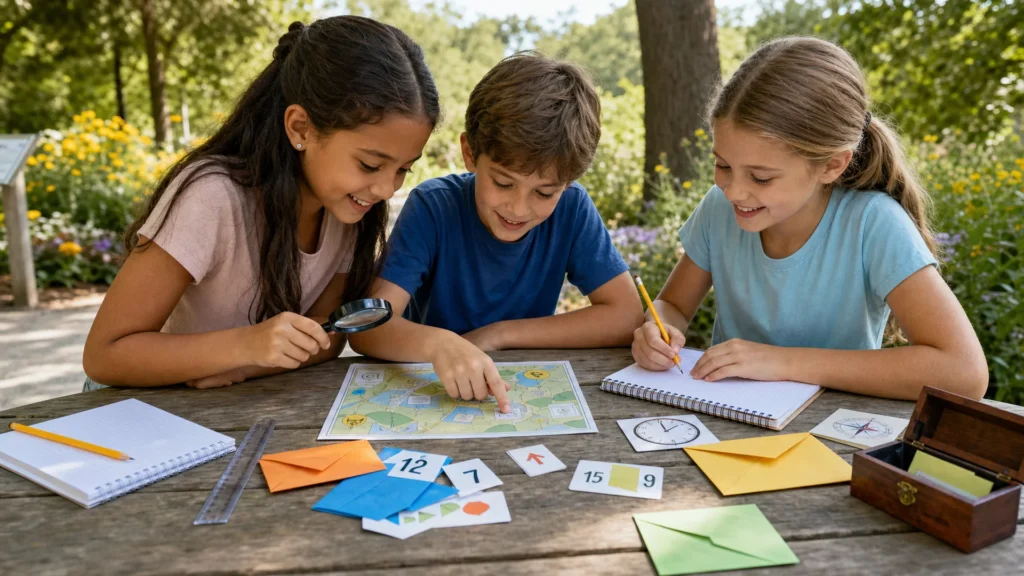
Allow siblings, family members, or a small group of students to solve a case together. Encourage learners to explain why they believe a clue matters and listen to different interpretations before choosing a solution.
The purpose is thoughtful discussion, not speed.
What to Look for in a Quality Math Mystery
A strong math mystery should provide:
- An engaging, age-appropriate story
- Mathematics suited to the learner’s grade level
- Clear directions
- Clues that contribute fairly to the solution
- Opportunities to organize information
- A solution supported by evidence
- Enough challenge to encourage reasoning without creating unnecessary frustration
- Answer support for parents or educators
The story should motivate the mathematics, not distract from it. Learners should be able to reach the solution by using the information and skills provided.
Introducing Engaging Math Mysteries
Encouraging Learning is developing Engaging Math Mysteries, a collection of grade-specific casebooks for learners in Grades 1–6.
Each case invites children to enter a story, examine clues, complete age-appropriate math challenges, and reason their way toward a verified solution. The mysteries are designed to strengthen mathematical thinking while giving learners an enjoyable reason to apply what they know.
The collection will support different grade levels and challenge levels so families and educators can choose cases suited to each learner’s developing abilities.
Helping Children Become Thoughtful Problem Solvers
Children need both skill practice and opportunities to apply those skills. Math mysteries help connect the two.
As learners read carefully, organize clues, complete calculations, test possibilities, and revise mistakes, they practice habits that extend well beyond a single worksheet or case.
They learn to pause before answering, explain their reasoning, and remain engaged when a solution is not immediately obvious.
Explore the Math & Problem Solving resources from Encouraging Learning and watch for the upcoming Engaging Math Mysteries collection. A good mystery can turn math practice into a problem-solving experience children are eager to complete.