Why a Blank Page Feels So Big, Even for Imaginative Kids
You hand your child a fresh sheet of paper, say “write a story,” and watch their eyes go wide. They love telling you wild tales about dragons and robots at the dinner table, but somehow that blank page turns them into a statue.
It is not that they do not have ideas. They may have too many.
The problem is the open-endedness. A blank page does not give any clues about where to start, what to include, or when to stop.
For a child whose mind is buzzing with possibilities, that freedom can feel overwhelming. Every idea seems to compete with the others, and before long, they are staring at the ceiling instead of the paper.
The answer is not necessarily more encouragement. Sometimes it is simply smaller steps.
When you break writing into playful, bite-sized pieces, some of the pressure disappears. That is where storytelling activities for kids can help.
Instead of asking for a full story, you ask for one small piece at a time. Maybe it is naming a character. Maybe it is describing where that character lives. Perhaps it is deciding what problem the character needs to solve.
Suddenly, the page does not look quite so empty anymore.
These activities can make it easier to get started because they give a child one manageable job to do. One prompt leads to one answer. That answer provides something to build on.
Before long, a child may have enough pieces to begin putting a story together.
Start Small With Prompts and Structure That Spark Ideas
The trick is to shrink the assignment until it feels more like creative play than a major writing project.
Instead of asking for an entire story, start with a single interesting question.
“What if your pet could talk for one day?”
“What would you put inside your dream treehouse?”
“What would happen if you opened your bedroom door and discovered a secret passage?”
Questions like these give children something concrete to grab onto. They do not have to invent an entire fictional world before writing the first word. They only have to respond to one idea.
These low-pressure prompts narrow the focus to one decision at a time. When a child only has to decide what the family dog would say about the mail carrier, there is no need to worry yet about plot twists, character development, or the perfect ending.
They can simply play with the idea.
You can also add a little structure to make the starting point even clearer.
Give your child a first sentence to finish, such as:
“The door creaked open and I saw…”
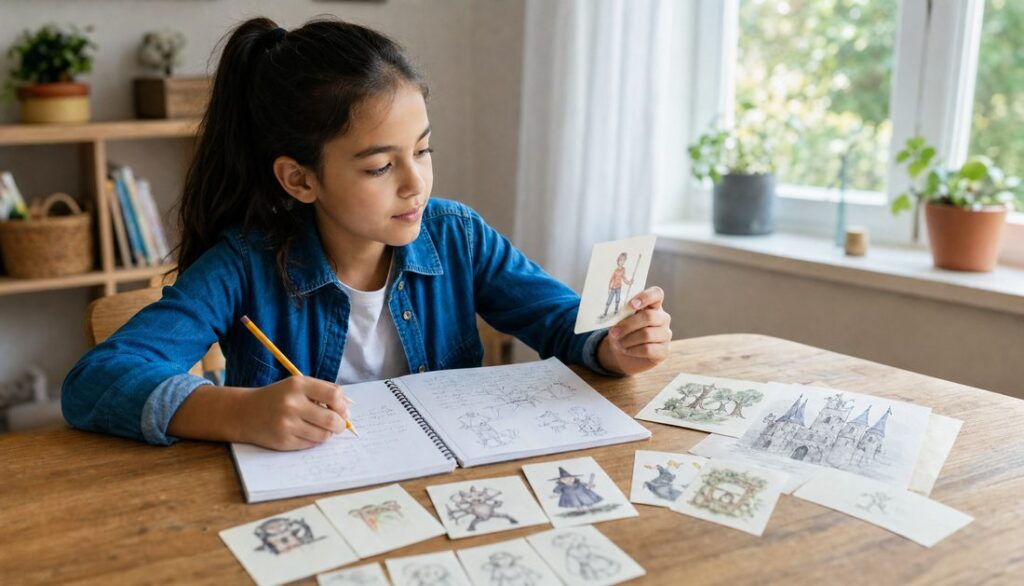
Or provide a picture of an unusual character, place, or object and ask what might be happening.
Simple storytelling activities for kids provide a gentle framework that can make starting easier without dictating where the story must go.
The goal is not to box children in. It is to show them that writing can begin with one manageable step.
Once they have that first idea or sentence on paper, they have something to build upon. The next question becomes easier: Who is in this story? Where are they? What happens next?
Building a Story Piece by Piece
Most stories are not one enormous idea. They are combinations of smaller pieces: a character, a place, a problem, a series of events, and some kind of resolution.
ReadWriteThink’s Story Map provides another useful way for children to organize characters, settings, conflicts, and resolutions before developing a complete story.
When children see storytelling that way, writing can begin to feel more like a building project than a magic trick.
Start with a character.
Have your child draw a goofy monster, a brave pirate, a curious inventor, or even a talking squirrel.
Then ask a simple question:
Where does this character live?
Maybe the monster lives in a castle made of pancakes.
Maybe the pirate lives on a bus that floats.
Now you have a character and a setting.
Next comes the problem. Ask what could go wrong.
The pancake castle is melting.
The floating bus has a flat tire.
The talking squirrel has forgotten where it buried something important.
Now there is something for the character to do.
From there, children can consider what happens first, what happens next, and how the problem might eventually be solved.
You do not need a lengthy lesson to explain that structure. You can simply build it together through a series of questions.
Sequencing activities can help too. Write several events on separate slips of paper, such as “The dragon woke up,” “The knight found a map,” and “They discovered the hidden cave.”
Ask your child to arrange the events in an order that makes sense. Then mix them up and see whether another order could create a different story.
Activities like this encourage children to think about how events connect before they have to worry about writing several paragraphs.
A story does not have to remain mysterious. It can simply begin with a character facing a problem and making choices about what happens next.
For more ways to explore this part of storytelling, see our article Why Creating Characters Helps Kids Become Better Storytellers.
Pictures, Comics, and Dialogue Can Become Bridges to Writing
Not every child begins an idea with sentences.
Some children first see pictures. Others sketch, doodle, act out scenes, or hear conversations between imaginary characters.
Those creative starting points can become useful bridges into written storytelling.
Try a picture prompt.
Show your child a photograph of a strange empty room, an abandoned treehouse, a mysterious path through the woods, or a lonely boat on a beach.
Then ask one question:
“What do you think happened here five minutes ago?”
There is no need to develop a complete plot. Your child can simply describe what they see or what they think might have happened.
You can even use familiar places. Take a photograph of your backyard or living room and challenge your child to invent something unexpected that happened there while everyone was asleep.
Comics provide another approachable option.
Ask your child to draw a simple three-panel comic. Stick figures are perfectly fine. They can add speech bubbles, facial expressions, movement, and sound effects.
Once the pictures are finished, ask them to write one sentence beneath each panel explaining what happened.
Without sitting down to write a conventional story, they have already created characters, actions, and a sequence of events.
Dialogue can work the same way.
Ask your child to write a short conversation between two unlikely characters, perhaps a grumpy cat and an overly cheerful robot.
The entire activity can simply be a back-and-forth conversation.
What would the cat complain about?
Why is the robot so cheerful?
What do they disagree about?
What might they eventually discover they have in common?
This lets children experiment with personality and character voice without needing to plan an entire plot first.
Another simple activity is to ask your child to draw any scene they want and then answer one question:
“What happens next?”
A drawing becomes a sentence. A sentence becomes another event. That event might eventually become a story.
These kinds of storytelling activities for kids allow children to approach writing from several directions instead of assuming every story must begin with a paragraph.
Let Stories Change Direction
Children sometimes treat the ending of a story like a locked door. Once the book closes, that is simply what happened.
But stories do not have to work that way.
Exploring alternate endings can show children that a story represents a series of creative choices. Change one choice and the entire story might head somewhere different.
Choose a short story you have recently read together.
After finishing it, ask:
“What if the main character had made a different choice?”
You may get a shrug at first. Give your child a playful possibility.
What if the wolf in the fairy tale was really searching for a sandwich?
What if the hero asked for help instead of going alone?
What if the character who seemed like the villain turned out to be trying to prevent something worse from happening?
The goal is not to create a “better” ending. It is to demonstrate that the original ending is one possible version rather than the only version anyone could imagine.
Once children understand that stories can change, they can experiment more freely with their own writing.
If something is not working, they do not necessarily have to throw away the entire story. They might change the problem, introduce a different character, alter an important decision, or try another ending.
Alternate endings can also become an easy family storytelling activity.
Read a short story together and have everyone suggest a different ending aloud. No writing is required.
The variety of answers reinforces a valuable creative idea: several people can begin with the same story and take it in completely different directions.
Keep Storytelling Practice Low Pressure
Not every storytelling activity needs to become a finished story.
That is important.
Sometimes a child can invent a character and stop there.
Another day, they might design an imaginary setting.
They might create a comic, write an unusual conversation, finish a story starter, rearrange a sequence of events, or invent three possible endings.
Each activity gives children an opportunity to make creative decisions without requiring them to produce several polished pages.
You can also keep activities short.
Try a five-minute storytelling challenge at the kitchen table. Choose three random objects nearby and invent a story that includes all three.
Pick a character, a location, and a problem from three separate containers and combine them.
Ask everyone in the family to contribute one sentence to a story.
Take turns adding details to an imaginary character.
These activities reinforce the idea that storytelling is something children can experiment with rather than something they must always perform correctly.
There is also no rule saying every story has to be realistic.
A refrigerator can talk.
A dog can become mayor.
A school bus can travel to Mars.
A pencil can refuse to write until someone solves its riddle.
Allowing unusual ideas to remain unusual gives children room to discover what they enjoy creating.
Support the Story Without Taking It Over
When your child is creating a story, one of the most helpful things you can do is remain curious about their ideas.
Instead of immediately correcting something that does not make sense, ask questions such as:
“What happens next?”
“Why did your character decide to do that?”
“What does this place look like?”
“How did the character feel when that happened?”
“What else could happen?”
Questions like these encourage children to think about their choices while allowing the story to remain their own.
Early drafts do not need to be perfect. A story with unusual spelling, an unexpected plot twist, or a character who suddenly changes direction can still provide useful creative practice. There will be opportunities to work on mechanics and revisions later.
For now, give children room to experiment.
It can also help to notice what they created rather than immediately evaluating it.
“You gave that character an interesting problem to solve.”
“I did not expect that ending.”
“You added a lot of detail to that setting.”
“That character made a surprising choice.”
Comments like these keep attention on the creative decisions the child made.
Give Young Storytellers Some Structure When They Need It
Some children will happily invent stories from almost nothing. Others enjoy having prompts and activities that provide a starting point.
Both approaches are fine.
If your child enjoys guided storytelling, Story Sparks! Creative Storytelling Workbook for Kids provides a structured way to continue exploring these ideas.
Designed for Grades 3–6, Story Sparks! includes 30 engaging activities covering characters, settings, story structure, picture prompts, comics, sequencing, alternate endings, and original story creation.
Children can build characters, design settings, invent challenges, explore beginnings and endings, work with visual prompts, experiment with comics, and gradually put their own stories together.
The purpose is not to tell children what their stories should become. It is to give them enough structure to get started and enough freedom to discover where their own ideas can take them.
One Small Story at a Time
Children do not have to begin by writing pages of polished prose.
A character sketch can be a beginning.
So can a three-panel comic.
An unusual setting can spark an adventure.
A conversation between two strange characters can reveal an entire story.
A different ending can send a familiar tale in a completely new direction.
That is what makes storytelling activities for kids so useful. They turn one potentially intimidating assignment into a series of smaller creative decisions.
Give children opportunities to make those decisions, follow their ideas, change direction, and try again.
The blank page does not have to demand an entire story all at once.
Sometimes it only needs one character, one question, one drawing, or one wonderfully strange idea to get things started.