
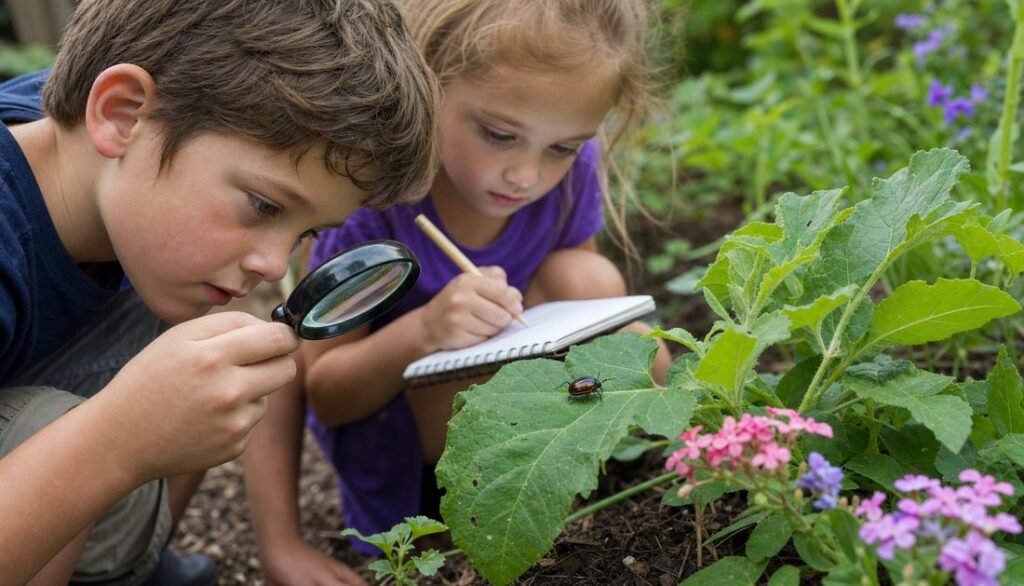
Why Tiny Creatures Reward a Closer Look
You step outside, and the world feels still for a second. Then you notice a single ant dragging a crumb across the pavement or a ladybug climbing a blade of grass.
These tiny creatures are everywhere, but they are also incredibly easy to walk right past.
We see the big picture, the green lawn or the tall tree, but often miss the small activity unfolding right at our feet.
That is where bug activities for kids can begin.
They are not about turning your backyard into a classroom or forcing a formal science lesson. Instead, they offer a simple invitation to slow down.
When you crouch beside your child to watch a beetle navigate a crack in the sidewalk, you give both of you a chance to notice details you might normally overlook.
You might see a flash of color on a wing or the way a caterpillar grips a leaf as it moves. You might begin wondering where it is going, what it will do next, or why you found it in that particular place.
That curiosity doesn’t require a textbook. It just needs a few quiet minutes and a willingness to look more closely.
You also don’t need to know the name of every insect you see.
You don’t need a field guide or a collection jar.
Observation itself can be the activity.
Bug Activities for Kids Can Begin With Watching
You don’t need a magnifying glass, field guide, or special equipment to get started.
You just need to stop and watch.
When observation becomes the main activity, there is no pressure to name the insect, catch it, or immediately figure out what it is doing.
You are simply giving it your attention for a few minutes.
Try the Five-Minute Bug Watch
Choose one insect, whether it’s a beetle on the sidewalk, an ant crossing a path, or a butterfly visiting a flower.
Watch it without touching or redirecting it.
What does it do first?
Does it stop?
Does it change direction?
Does it climb?
Does it disappear beneath a leaf?
How many different things can your child notice in five minutes?
Follow an Ant
Choose one ant and watch where it travels.
See how far you can follow its path before it disappears beneath a leaf, enters a crack, or becomes difficult to distinguish from the others.
The challenge is simply to keep track of the same ant without interfering with what it is doing.
Once children become comfortable watching instead of immediately touching or collecting, they may begin noticing more details on their own.
And that leads to an especially useful question:
“What did you actually see?”
What Did You Actually See?
You watch a beetle cross the pavement.
It stops, turns, crawls underneath a leaf, and disappears.
Ask your child what happened, and they might say:
“It hid because it was scared.”
That could be one possibility, but it isn’t what they actually observed.
What they saw was simpler:
The beetle crawled underneath the leaf.
There is a useful difference between an observation and an explanation.
Children don’t need formal terminology to explore that difference.
Try asking:
“What did you actually see?”
“What makes you think that?”
“What else could explain it?”
If your child says an ant is lost, ask what they noticed that led them to that idea.
Perhaps the ant stopped several times and repeatedly changed direction.
Those are observations.
Whether the ant was actually lost is something you don’t yet know.
The goal isn’t to correct children every time they offer an explanation. Their ideas and questions are part of the exploration.
Instead, help them notice the difference between something they directly observed and something they think might explain it.
That distinction gives them another reason to look closely.
Look at How Bugs Move
Once you start watching carefully, one of the easiest things to notice is movement.
A grasshopper doesn’t move like a caterpillar.
A butterfly doesn’t travel like a beetle.
Ask:
“How does this one move?”
Does it walk?
Crawl?
Hop?
Fly?
Climb?
Stop suddenly?
Change direction?
Move quickly or slowly?
Children may describe movement in their own words, and that’s fine.
“It walks really fast.”
“It keeps stopping.”
“It flies in loops.”
“It crawls underneath things.”
These are useful descriptions of what they can see.
Then look at where you found the creature.
A tree trunk may have different visitors from a flower bed. A sunny sidewalk offers different conditions from the damp ground beneath a log.
Instead of trying to explain immediately why a particular insect is there, begin with what you can observe about the location.
Is it sunny or shady?
Wet or dry?
On a plant or on the ground?
Near flowers?
Underneath something?
These details can lead to more questions later.
One Small Space Can Hold a Lot to Discover
A whole backyard can be overwhelming when you’re trying to notice something tiny.
Make the search smaller.
Choose one tree trunk.
One flower bed.
One patch of grass.
One bush.
One section of garden.
Then investigate only that area for a few minutes.
Ask:
“What can we find here?”
Children may initially see nothing.
Give it time.
Look at the top and underside of leaves. Watch the ground. Examine bark without pulling it apart. Notice flowers and stems.
You might find ants moving through the soil, a beetle resting on a leaf, a spider web between branches, or a butterfly stopping briefly at a flower.
Then try another small area and compare.
“What did we find here that we didn’t see over there?”
You can even return to the same spot on another day.
Children who enjoy recording what they discover outdoors may also like Why Nature Journaling for Kids Is Worth Trying, where we explore simple ways to turn observations, sketches, and questions into an ongoing nature journal.
The insects you see today may not be the ones you find tomorrow.
Draw It Before You Look It Up
Drawing gives children another reason to slow down and examine what is actually in front of them.
The goal isn’t to create a beautiful picture.
It is to try to record visible details.
If your child is sketching a beetle, they may begin asking:
How many legs can I see?
What shape is its body?
Are there visible sections?
What colors do I notice?
Can I see wings?
Are the antennae long or short?
A simple sketch can capture details that might otherwise be forgotten.
Compare Two Bugs
Find two different insects and sketch them side by side.
Your child doesn’t need to know their names.
Instead, compare what is visible:
- size
- color
- body shape
- visible legs
- wings
- antennae
- movement
- where each insect was found
Then ask:
“What is the biggest difference you notice?”
“What looks similar?”
Create a Bug Observation Page
A simple observation page might include:
Date:
Location:
Weather:
What I saw:
Colors I noticed:
How it moved:
What it was doing:
My sketch:
Questions I still have:
Children can write as much or as little as they want.
A drawing and one sentence can be enough.
Try recording the observation before opening a field guide or searching online. That keeps the first part of the activity centered on the actual creature in front of you.
Afterward, identification can become another part of the investigation.
Questions Are Part of the Discovery
Children ask plenty of “why” questions.
Why does it have those colors?
Why did it fly away?
Why is it sitting on that flower?
Why does it have such long legs?
You don’t have to know every answer.
Instead of immediately supplying one, try responding with another question:
“What do you notice?”
“What makes you wonder that?”
“What changed?”
“Where did it go?”
“What is different about this one?”
“How could we find out?”
Sometimes you can investigate the answer together afterward.
Other questions may remain unanswered.
That is okay too.
Families who want to continue exploring can visit the Smithsonian’s What Is an Insect? resource, where children can learn about the features insects share and practice observing and comparing different creatures. Museum of Natural History for additional information about insects and the natural world.
Nature observation doesn’t require solving every mystery. Sometimes noticing something new is enough to make the experience worthwhile.
Observe Without Disturbing
Curiosity works best when it comes with respect for the creatures being observed.
Whenever possible, watch rather than capture.
Avoid damaging nests or other habitats.
If you carefully move something such as a small rock or piece of wood to look underneath, return it to its original position.
Children should not handle unfamiliar insects.
Bees, wasps, and other potentially defensive insects are best observed from a comfortable distance.
And after outdoor exploration, washing hands is a sensible routine.
These simple habits allow children to investigate while minimizing their impact on the creatures and places they are exploring.
The Backyard Is Bigger When You Look Smaller
The beauty of bug activities for kids is that they don’t require a special trip.
A backyard can work.
So can a garden, park, sidewalk, tree, porch light, or patch of grass.
The activity begins when children stop walking past and start looking closely.
An ant becomes something to follow.
A beetle becomes something to sketch.
Two insects become something to compare.
An unexpected movement becomes a question.
And a single leaf can become a place worth investigating for several minutes.
Children don’t need to identify everything they find or remember a collection of scientific facts for the experience to be worthwhile.
They can simply observe.
Ask questions.
Draw.
Compare.
Wonder.
Then come back another day and see what has changed.
Sometimes discovering more about nature begins by looking at a much smaller piece of it.