
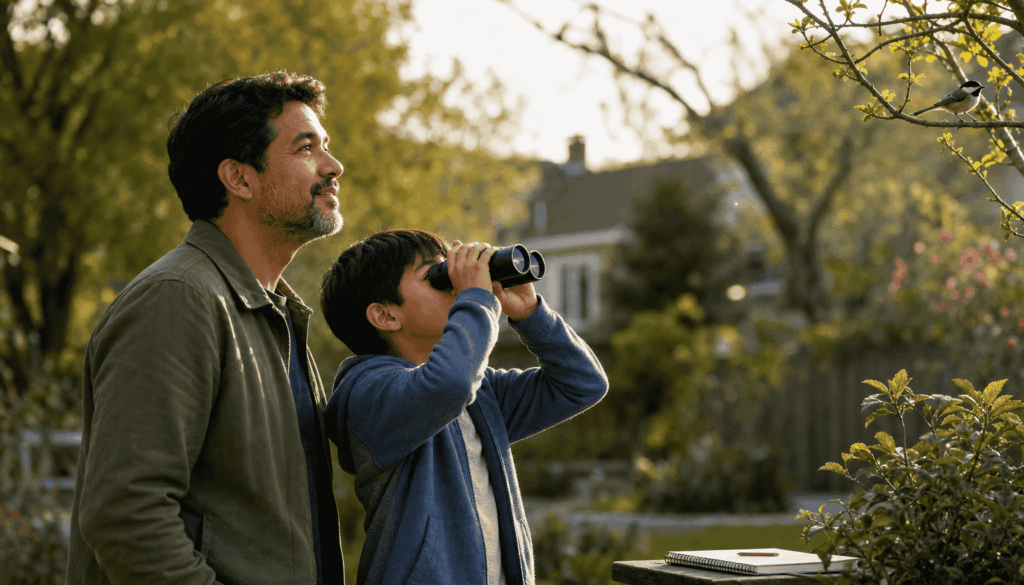
You don’t need a field guide, a fancy pair of binoculars, or a degree in ornithology to enjoy bird watching with kids. In fact, not knowing all the answers can become part of the adventure.
When you don’t immediately know what kind of bird you are watching, you get to investigate alongside your child.
The real value of bird watching with kids isn’t checking species off a list. It’s slowing down long enough to notice that one bird hops while another walks. It’s hearing a repeated call and wondering which bird is making it. It’s watching a bird disappear into a shrub and becoming curious about what it might be doing there.
The goal is simple: encourage curiosity and strengthen observation skills.
You can start from a kitchen window, porch step, backyard, neighborhood sidewalk, or bench at a local park. No special destination is required.
Pick a spot, become quiet, and look.
Your child might ask a question you can’t answer, such as, “What is that bird carrying in its beak?”
That is a perfect opportunity to say, “I’m not sure. Let’s watch and see where it goes.”
You aren’t expected to have every answer. Investigating something together demonstrates exactly how curiosity works.
Bird identification can come later.
Observation comes first.
What Kids Can Learn From Watching Birds
Every time a child stops to watch a bird, there is an opportunity to practice careful observation.
Kids naturally look at things, but bird watching encourages them to look with greater intention.
You might ask a simple question such as, “What color is its chest?” or “Does it hop or walk?”
Suddenly, the child isn’t just seeing a blur of feathers. They’re noticing details such as the shape of a beak, markings on the wings, the way the bird moves, or how it tilts its head.
Then there is listening.
Birds are often heard before they are seen. When children become quiet and try to determine where a sound is coming from, they begin paying attention to noises that normally blend into the background.
They may notice that one bird repeats a short call while another produces a longer song. They might hear several birds calling from different directions.
There is no need to identify every sound. Simply recognizing differences is valuable observation.
Bird watching also provides natural opportunities to practice patience.
Sitting quietly for even a few minutes can be challenging at first. But when a bird finally lands nearby or emerges from a bush, children begin to understand why waiting and watching can be worthwhile.
These experiences also introduce some basic habits of scientific thinking.
A child might wonder why a bird keeps returning to the same part of the lawn. Perhaps it is looking for food. Instead of immediately supplying an answer, you can keep watching together.
Question. Guess. Observe. Compare.
Those are useful habits whether or not anyone ever identifies the bird.
Bird Watching With Kids: A Simple Way to Begin
The easiest way to start is to choose a place where you are comfortable and birds are already present.
A backyard, porch, schoolyard, neighborhood green space, or local park can work perfectly well. There is no need to travel somewhere special.
Once you have chosen a spot, try these simple steps.
1. Get Comfortable and Become Quiet
Let your child choose a comfortable place to sit or stand.
Then spend three to five minutes simply being quiet.
Birds that moved away when you arrived may begin returning to their normal activities once things settle down.
For younger children, even a couple of quiet minutes can be enough.
2. Watch for Movement
Instead of trying to find an entire bird among hundreds of leaves and branches, look for movement.
Watch for a flutter, hop, branch movement, or sudden flash of color.
Movement gives your eyes a smaller area to investigate.
3. Listen Before You Look
Become quiet and listen.
Where is the chirping coming from?
Does it seem high in a tree, close to the ground, or somewhere inside a shrub?
You can even close your eyes briefly and point toward the direction of different sounds.
Bird watching quickly becomes bird listening.
4. Return to the Same Place
One of the most useful things you can do is return to the same observation spot on different days.
You don’t need long sessions. Ten minutes can reveal something completely different from what you saw the previous day.
Over time, familiar surroundings begin to feel less familiar because children start noticing details they previously overlooked.
What to Notice Before You Know the Bird’s Name
Not knowing a bird’s name does not prevent a child from making useful observations.
Think of yourselves as detectives gathering clues.
Start with size.
Instead of worrying about exact measurements, compare the bird with something familiar. Is it tiny, medium-sized, or large? Is it smaller than another bird nearby?
Next, look at colors and markings.
What color is its chest? What about its back or head? Does it have stripes, spots, patches, or contrasting colors?
Look at the beak.
Is it short or long? Thick or thin? Straight or curved?
The shape of a bird’s beak can offer clues about how it feeds, although children do not need to determine the answer immediately.
Then watch how the bird moves.
Does it hop or walk? Does it climb along a tree trunk? Does it flick its tail? Does it spend most of its time on the ground or in branches?
Watch its flight if you have the opportunity.
Does it fly directly from one place to another? Does it glide? Does its flight rise and fall?
Listen too.
Is the bird making a short call or a longer song? Is the sound loud or soft? Does it repeat the same pattern?
Finally, notice what the bird is doing.
Is it eating? Carrying something? Bathing? Singing? Searching through leaves? Sitting quietly? Interacting with another bird?
You can also notice whether it is alone, in a pair, or part of a larger group.
By the time you have gathered these observations, you know quite a bit about the bird even if you still don’t know its name.
“I don’t know what bird that is” isn’t a dead end.
It’s the beginning of an investigation.
Bird Watching Is Also Bird Listening
Children often begin bird watching by searching the trees with their eyes, but some of the most interesting discoveries begin with their ears.
Try sitting quietly for one minute without looking for anything.
How many different bird sounds can you hear?
Ask children to describe sounds in their own words.
Is the sound high or low?
Fast or slow?
Is it one note or several?
Does it repeat?
Is it a whistle, chirp, trill, chatter, or something harder to describe?
Children do not need to memorize bird songs or reproduce them accurately. The goal is simply to recognize that different birds make different sounds and that listening provides another way to investigate wildlife.
Over time, children may begin recognizing familiar sounds before they ever see the bird making them.
That can make an ordinary backyard feel surprisingly alive.
Simple Ways to Record Bird Discoveries
A notebook or nature journal can add another dimension to bird watching without turning the activity into schoolwork.
Children might:
- Sketch a bird they observed
- Record its colors or markings
- Write down where they saw it
- Describe what it was doing
- Record the date and weather
- Describe a bird sound
- Make tally marks for repeated sightings
- Draw a feather they discovered
- Record questions they want to investigate
- Compare two different birds
The entries don’t need to be detailed.
A quick sketch with a few labels may capture everything a child wants to remember.
Recording observations also allows children to return to earlier discoveries. They can compare birds seen during different seasons, notice which birds appear repeatedly, or see how their own observation skills develop.
Keeping Younger Bird Watchers Interested
A long, silent bird watching session probably isn’t the best introduction for a young child.
Keep early experiences short and playful.
Try a five-minute challenge:
“How many birds can we find?”
Or focus on a single characteristic:
“Can we find a bird with red somewhere on its body?”
Other simple challenges might include:
- Find the smallest bird you can see.
- Find the largest bird.
- Listen for three different bird sounds.
- Find a bird on the ground.
- Find a bird high in a tree.
- Watch one bird and describe what it does.
- Compare two birds.
- Draw your favorite bird from today.
If your child becomes fascinated by one bird, follow that interest.
There is no requirement to observe a certain number of species or complete a checklist.
When attention begins to fade, stop.
Leaving a child curious about what they might see next time is better than extending the activity until it becomes a chore.
Watching Birds Respectfully
Bird watching also provides an opportunity to teach children how to observe wildlife responsibly.
The basic rule is simple: watch without interfering.
Children should not chase birds, throw objects to make them move, attempt to touch them, or approach nests closely.
If a bird changes its behavior because you have moved closer, give it more space.
Nests deserve particular care. Children may be excited to discover one, but observation should happen from a respectful distance. Eggs, chicks, nests, and nesting materials should be left undisturbed.
Good wildlife observation allows animals to continue behaving naturally.
That principle can become part of a child’s broader understanding of how people interact responsibly with the natural world.
Why Returning to the Same Place Matters
It can be tempting to think that finding new places will produce better bird watching experiences.
Sometimes the opposite is true.
Returning to the same backyard, window, trail, or park gives children a chance to notice patterns.
A bird that seemed completely unfamiliar during the first observation may become recognizable after several encounters.
Children may notice that certain birds appear at particular times of day. They might discover that one species prefers the ground while another stays high in the trees.
Weather can change what they observe.
Seasons can change which birds appear.
Spring may bring nesting behavior. Different foods may become available at different times of year. Trees gain and lose leaves, changing both bird behavior and how easily birds can be seen.
Repeated observation turns a familiar place into something worth investigating again and again.
You Don’t Have to Know the Name to Make a Discovery
It is easy to assume successful bird watching means correctly identifying everything you see.
For children, that can put the emphasis in the wrong place.
Identification is useful and can become part of the experience, but it does not have to come first.
A child who can tell you that a small brown bird was searching under leaves, had a short beak, made a repeated two-note call, and flew into a nearby shrub has made a collection of meaningful observations.
The bird’s name can be investigated later.
What matters first is that the child stopped long enough to notice.
So choose an ordinary place. Become quiet for a few minutes. Watch for movement. Listen carefully. Ask questions you may not know how to answer.
Then come back another day and see what has changed.
Children do not need to know the name of every bird to become good observers of the natural world.
They simply need opportunities to stop, look, listen, notice, and wonder.