
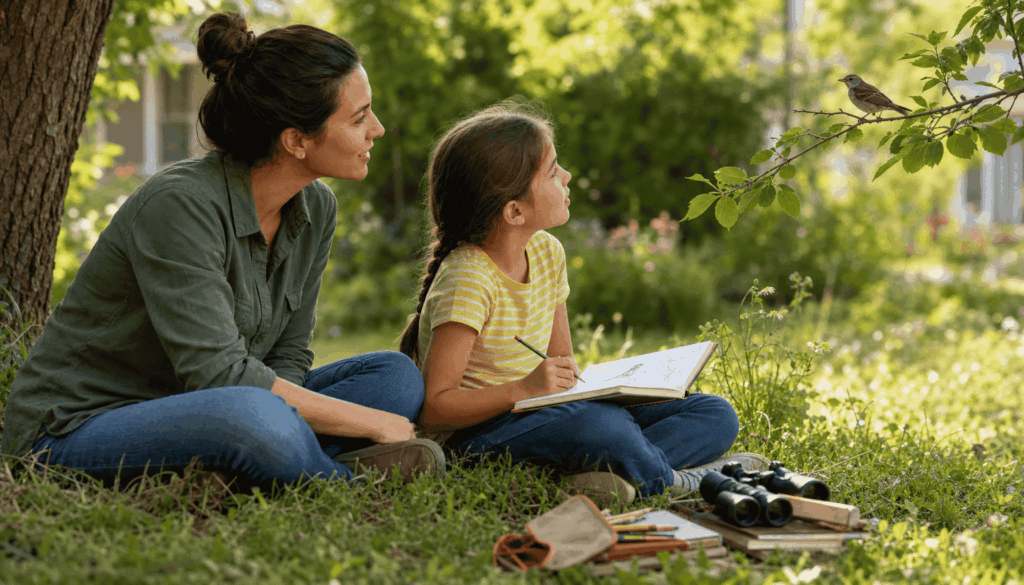
Most kids don’t need another assignment. They need a reason to look closer at the world around them, and that’s exactly where nature journaling for kids comes in.
At its core, nature journaling is a simple activity. A child opens a notebook, heads outside, and records what they notice.
Maybe they sketch a ladybug crawling up a stem. Maybe they write down that the wind sounds different today than it did yesterday. Maybe they paste in a fallen leaf and scribble a question about why it turned red.
The key difference from schoolwork is ownership.
A worksheet usually asks for a specific response. A nature journal asks a child to decide what deserves attention. There may be observations, questions, drawings, labels, comparisons, or simply a few words describing something interesting.
It becomes a personal record of what caught a child’s eye, which means the curiosity comes from them rather than from a prompt at the top of a page.
That shift matters.
When kids aren’t worried about being graded or tested, they have room to slow down. They may start comparing the shapes of clouds from one week to the next. They might notice that the same patch of sidewalk hosts different ants at different times of day. They begin asking “why” without worrying about whether it is the right question.
This isn’t about turning every walk into a science lesson. It’s about giving kids permission to explore at their own pace, with their own pencil, in their own words.
What Kids Actually Gain From Keeping a Nature Journal
The real payoff is quieter than you might expect. It’s not about raising a junior scientist or a future illustrator.
It’s about the way a child begins to look at the backyard differently after spending time observing and recording what is there.
A child who journals regularly may begin to notice the difference between one bird’s song and another. They might observe that the same patch of moss looks dry and crisp one day but plump and green after rain.
These aren’t grand intellectual leaps. They’re small, repeated acts of paying attention.
That habit builds useful skills.
Drawing a beetle encourages a child to look carefully at how many legs it has and which direction its antennae bend. Writing a sentence about the sky requires choosing words that describe what is actually visible.
Children aren’t simply practicing drawing or writing in the abstract. They’re using those skills to capture something specific that they have observed.
Nature journaling can also encourage scientific thinking without requiring a formal science lesson.
When a child asks, “Why are there more ants on this side of the sidewalk?” they have identified something worth investigating. When they flip back a few pages to compare today’s observations with something they recorded last week, they are beginning to look for patterns and changes.
The activity naturally encourages children to notice, question, compare, and wonder.
Nature Journaling for Kids Does Not Require Special Supplies
You don’t need to be an artist, a biologist, or an outdoor survival expert to help a child begin.
Nature journaling is about noticing, not producing museum-quality sketches.
You also don’t need expensive supplies.
A spiral notebook and a pencil from the kitchen drawer are plenty. If your child prefers crayons or colored pencils, those can be useful too, but none of them are required.
You don’t need access to a wilderness area either.
A backyard, sidewalk, schoolyard, neighborhood park, or even the view from a window can provide plenty to investigate. A single dandelion pushing through a crack in the pavement can lead to drawings, observations, comparisons, and questions.
The important part is not where children explore. It is whether they begin paying attention to what is around them.
What Can Kids Put in a Nature Journal?
Almost anything they notice can become a journal entry.
Start with whatever catches their attention.
That might be a bird hopping across the lawn, an ant hauling a crumb, or the way clouds change shape over ten minutes.
Children can record:
- Birds they see or hear
- Insects and other small creatures
- Leaves, flowers, trees, and plants
- Weather conditions
- Clouds and changes in the sky
- Animal tracks or other signs of wildlife
- Feathers and nests
- Seasonal changes
- Colors and shapes found outdoors
- Sounds they hear
- Questions about things they discover
Encourage children to notice sounds as well as sights.
What does a particular bird sound like? How does wind moving through one tree sound different from wind moving through another? What sounds disappear when everyone becomes quiet for a minute?
Colors, shapes, textures, movement, and patterns can all become part of an observation.
A child might ask whether a leaf is more yellow than orange. Another might notice that a rock looks like an egg. Someone else may become fascinated by the trail left behind by a snail.
There is no single correct way to fill the page.
That freedom is part of what makes nature journaling feel like exploration rather than another assignment.
A Simple, Flexible Nature Journaling Routine
Nature journaling doesn’t require a rigid schedule.
For many families, short and repeated opportunities are easier to maintain than setting aside a large block of time. Ten or fifteen minutes can be enough to notice something, record it, and close the notebook while the experience is still enjoyable.
You might journal after school, before dinner, during a weekend walk, while visiting a park, or whenever your family is already spending time outdoors.
Some children may enjoy returning to their journals several times a week. Others may use them primarily during nature walks, trips, or seasonal activities.
Follow your child’s interest.
If they want to spend an entire session drawing the same ant they have watched several times before, let them. Repeated observation can reveal things they missed the first time.
If they would rather write a silly poem about clouds than make a scientific sketch, that can belong in a nature journal too.
The habit of observing and recording matters more than following a particular format.
When Your Child Does Not Know What to Write or Draw
There will probably be days when your child stares at a blank page and says, “I don’t know what to do.”
That doesn’t mean nature journaling isn’t working.
Instead of giving them a complete assignment, offer one small question.
Try:
“What’s the first thing you noticed when we stepped outside?”
Or point to something nearby and ask:
“What are three things you notice about that leaf?”
You can also narrow the focus dramatically.
Instead of saying, “Journal about nature,” try:
“Sketch one thing that is moving.”
“Write down every color you can see from where you’re sitting.”
“Find something smaller than your thumb.”
“Listen quietly for one minute. What sounds do you hear?”
“What do you wonder about this flower?”
A small prompt can get the pencil moving without taking ownership of the journal away from the child.
Once they begin, curiosity often provides the next question.
Letting the Journal Grow Along With Your Child
One of the best things about nature journaling for kids is that it can change as children grow.
The journal can develop alongside their skills, interests, vocabulary, and attention span.
A four-year-old might fill a page with a giant scribbly dandelion and one word: “yellow.”
That is a perfectly useful observation.
A seven-year-old might draw the same dandelion and add a few lines about the bees circling it.
A ten-year-old might sketch the leaf shape, measure the stem with a ruler, identify the plant, or compare it with an entry made several weeks earlier.
There is no need to force this progression.
For younger children, drawing, labeling, matching, counting, and simple observations may be enough. Ask them to find two leaves that look alike or draw a cloud that reminds them of an animal.
Keep it playful.
Older children may be ready to write descriptions, count flower petals, compare observations from different dates, take measurements, identify species, or research something they have discovered.
The way you ask questions can make a difference.
Instead of saying, “Write three sentences about this tree,” try asking, “I wonder how tall that tree is compared with our house. What do you think?”
That question can invite estimation, comparison, measurement, drawing, or writing without turning the experience into a checklist.
And if your child isn’t interested that day, it is fine to put the notebook away.
The journal belongs to the explorer.
The Journal Is a Record of Discovery, Not Perfection
A nature journal does not need to be neat, complete, or impressive.
Some pages may contain detailed drawings and careful observations. Others may have a few words, a quick sketch, or a question your child cannot answer yet.
Those unanswered questions can become some of the most interesting entries.
They give children something to investigate later and demonstrate an important part of learning: discovery often begins with noticing something you do not understand.
Children can also return to earlier entries.
They might compare the first flower they spotted in spring with one they find several weeks later. They can look at drawings of birds from different seasons, compare weather observations, or see how their ability to describe what they notice has changed.
Over time, the journal becomes more than a collection of activities.
It becomes a record of what a child noticed, wondered about, investigated, and learned.
The Real Goal: Raising Kids Who Notice and Wonder
Every time a child pauses to watch a caterpillar inch across the sidewalk or asks why the sky turns orange at sunset, something important is happening.
The journal is simply a place to hold those moments.
It is a tool, not the goal itself.
The larger goal is helping children move through the world with open eyes and curious minds.
Some days the notebook will get used. Other days it may sit untouched while your child watches clouds, listens for birds, or investigates something interesting in the grass.
That counts too.
The noticing is what matters, not how many pages get completed.
You may see the habit appear unexpectedly. Your child might point out a spider web sparkling with dew and wonder how it was built. They may recognize a bird they have seen before or flip back through their journal to compare this spring’s discoveries with earlier observations.
Those moments show that curiosity is becoming a habit.
So start small.
Grab a notebook, step outside for a few minutes, and ask one simple question:
What do you notice?
Write, sketch, label, count, compare, or simply wonder about whatever comes next.
A nature journal does not need to turn the outdoors into another classroom. At its best, it does something much simpler.
It helps a child learn to notice a world that was already there.