
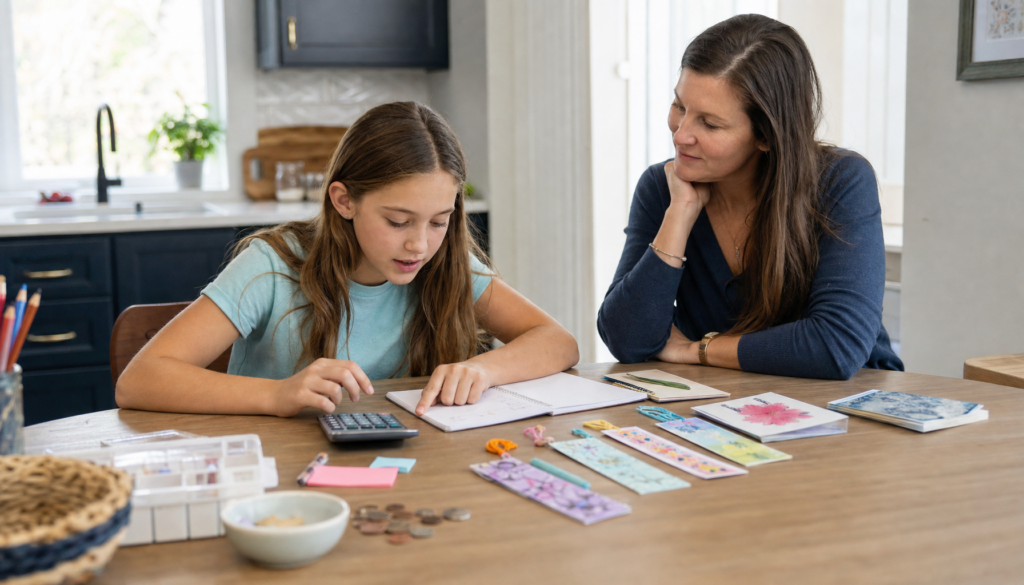
A child makes five handmade bookmarks and sells each one for $1.
Five bookmarks sold.
Five dollars collected.
“I made five dollars!”
It certainly looks that way.
Then comes an important question:
“How much did it cost to make the bookmarks?”
There was cardstock.
Ribbon.
Markers.
Glue.
Some of those supplies may already have been around the house. Others may have been purchased specifically for the project.
Either way, the question introduces an important idea:
Money collected is not necessarily money earned.
That simple distinction is a useful starting point for teaching business money skills for kids.
A small project gives children something concrete to work with. Instead of learning financial vocabulary in isolation, they can connect numbers to decisions they actually made.
What did we spend?
What should we charge?
How much money came in?
What remains after the costs?
What should we do differently next time?
The project does not need to become a serious business.
The value comes from helping children understand what the numbers mean.
Business Money Skills for Kids Start With Cost
Before deciding how much something should sell for, children need to understand what went into creating it.
Start with a simple question:
“What did we need to make this?”
For a bookmark project, the answer might include:
- Cardstock
- Ribbon
- Markers
- Glue
- Decorative materials
Then ask:
“Which of these things cost money?”
Children sometimes think materials already in the house are free because they did not personally purchase them.
That creates another useful conversation.
The cardstock in the printer did not appear by itself.
Neither did the ribbon in the craft drawer.
Someone purchased those supplies.
For a simple children’s project, there is no need to calculate the exact fraction of every marker or bottle of glue that was used.
Keep the numbers manageable.
Perhaps the family decides that the materials used for one batch of bookmarks cost approximately $4.
Now the child has a starting point.
Cost is what we spend to make or provide something.
As children become more comfortable with the concept, they can begin identifying costs themselves.
Ask:
“What will you need?”
“Do we already have some of it?”
“What will we need to buy?”
“About how much will that cost?”
The goal is not perfect accounting.
It is understanding that creating something usually requires resources, and those resources affect the money side of the project.
Price Is a Decision
Once a child understands cost, another question appears:
“How much should I charge?”
Price is the amount someone is asked to pay for a product or service.
There is not necessarily one perfect answer.
Suppose a child is making bookmarks.
Parents can help the child think through questions such as:
What did the materials cost?
How much work goes into making each one?
What might someone reasonably pay for this?
What happens if the price is higher?
What happens if the price is lower?
The parent does not need to announce the correct price.
Let the child think.
Perhaps the first price turns out to be too low.
Perhaps people are unwilling to pay the higher price.
Perhaps the child realizes that the product takes so much time to make that the original plan is not practical.
Those are useful discoveries.
Pricing becomes an exercise in decision making rather than simply attaching a number to something.
Revenue and Profit Are Different
This is where a small project can teach a particularly useful money concept.
Suppose a child sells 10 bookmarks for $2 each.
The project brings in:
10 × $2 = $20
That $20 is revenue.
Revenue is the money that comes into the project from sales.
Now suppose the materials used for that batch cost $8.
Subtract the cost:
$20 revenue – $8 cost = $12 profit
The $12 is the profit.
For a simple children’s project, the distinction can be explained this way:
Revenue is the money that comes in.
Profit is what remains after the costs are subtracted.
This helps children understand why saying “I made $20” does not always tell the entire story.
A project can collect a substantial amount of money while also costing a substantial amount to operate.
Children do not need complicated accounting terminology to understand the basic relationship.
Money came in.
Money also went out.
Both numbers matter.
What Happens When the Numbers Don’t Work?
Not every project produces a profit.
Suppose a child spends $12 on materials for painted flowerpots.
Only two pots sell for $4 each.
The project brings in $8.
But the materials cost $12.
At this point, the numbers tell us that the project has not recovered its costs.
That does not need to become:
“You failed.”
It can become:
“What happened?”
Then:
“What could we change?”
Maybe fewer supplies should have been purchased initially.
Maybe the product costs too much to make.
Maybe the price needs reconsideration.
Maybe a different product would make more sense.
Maybe the child simply decides this particular project is not worth continuing.
The numbers provide information that can help with the next decision.
That connects business money directly with problem solving.
Introduce a Simple Project Budget
Another useful lesson can happen before anything is purchased.
Suppose a child has $10 available for a project.
Instead of heading immediately to the store or ordering supplies, make a plan.
Ask:
“What do you need?”
“How much money do you have available?”
“Which supplies are most important?”
“What happens if something costs more than you expected?”
Perhaps the original plan requires $14 worth of materials.
Now there is a decision to make.
Could something less expensive be used?
Could the project begin on a smaller scale?
Is there already something at home that could work?
Should the child choose another idea?
This is budgeting in a very practical form.
A budget is a plan for how available money will be used.
For children, it does not need to be more complicated than that.
Let Kids Make Some of the Money Decisions
Suppose the project does earn a profit.
What happens to the money?
There does not need to be one universal answer.
A child might decide to:
- Save some
- Spend some
- Put money toward a specific goal
- Use some to fund another project
- Give some, if that fits the family’s choices
Instead of immediately deciding for the child, ask:
“What would you like this money to do?”
Then talk through the possibilities.
If all of it is spent now, what does that mean?
If some is saved, what could it eventually be used for?
If some goes back into the project, what could the child make next?
The lesson is not that one choice is always correct.
The lesson is that money creates choices, and those choices can be considered before acting.
These same everyday decisions are also useful for building broader financial literacy for kids, especially when children have opportunities to practice saving, spending, planning, and making choices with real money.
Business Projects Give Everyday Math a Purpose
A small entrepreneurship project can make ordinary math immediately useful.
Children may find themselves using:
- Addition
- Subtraction
- Multiplication
- Estimation
- Comparing numbers
- Counting money
- Simple percentages for older children
But the project does not need to feel like disguised homework.
The math answers questions the child actually wants answered.
“How much will five of these cost to make?”
“How much money came in?”
“What is left after our costs?”
“Can I afford enough supplies to make another batch?”
“Which option costs less?”
Suddenly, the numbers have a purpose.
A multiplication problem is not simply ten times two.
It answers:
“If I sell ten bookmarks for $2 each, how much revenue will the project bring in?”
That connection can make abstract money concepts much easier to understand.
Let Small Mistakes Become Money Lessons
Children will make imperfect decisions.
They may buy too many materials.
Set a price too low.
Make more products than anyone wants.
Forget to include a cost.
Spend project money before figuring out what actually remained after expenses.
Those moments can become part of the learning experience.
Instead of:
“I told you that price was too low.”
ask:
“What did the numbers teach you?”
Then:
“What would you do differently next time?”
Perhaps the child decides to make five products before making twenty.
Perhaps materials should be priced before deciding what to charge.
Perhaps project money needs to stay separate until costs have been calculated.
A small, manageable mistake gives children information they can use on the next attempt.
Parents Can Guide Without Running the Project
Children will need help.
Parents may need to provide supervision, establish safety boundaries, explain unfamiliar concepts, assist with calculations, purchase materials, or help children understand practical limitations.
But there is a difference between guiding the project and taking it over.
Suppose a child chooses a price that seems too low.
Instead of immediately changing it, ask:
“If you sell five at that price, how much money comes in?”
Then:
“How much will the materials cost?”
Let the child look at the numbers.
If the child recognizes the problem, the lesson belongs to them.
The same principle applies to budgeting.
Rather than building the entire budget yourself, help the child identify what belongs on it.
An imperfect decision the child understands can provide more learning than a perfect decision made entirely by an adult.
Money Is Only One Part of the Project
Profit is easy to measure.
That does not make it the only measure of whether a children’s project was worthwhile.
A project might produce very little profit while giving a child opportunities to practice:
- Planning
- Budgeting
- Math
- Communication
- Responsibility
- Decision making
- Problem solving
- Persistence
A project might even cost slightly more than it brings in.
If the amount involved is small and appropriate for the family, the experience can still provide useful information.
What did the child discover?
Which assumptions were wrong?
What would they change?
Did they enjoy making the product?
Did they enjoy explaining it to people?
Would they choose a completely different project next time?
These questions broaden the experience beyond:
“How much money did you make?”
Connect the Numbers to the Bigger Entrepreneurship Journey
Before children begin working deeply with prices and profit, it can help to understand how those numbers fit into a larger project.
An idea usually starts somewhere else.
A child notices a problem or opportunity.
Develops an idea.
Thinks about who it could help.
Creates a simple plan.
Tests something.
Then money becomes one part of deciding whether the idea works.
Our guide to entrepreneurship for kids explores that broader process of moving from an everyday idea to a project, gathering feedback, and improving what was created.
For families who want structured activities, the Young Entrepreneur Adventure: Business, Money & Leadership Learning Pack for Kids gives children opportunities to explore business ideas, customers, branding, pricing, costs and profit, money math, budgeting, saving, marketing, pitching, feedback, and planning.
The purpose is not to turn a child’s project into a miniature corporation.
It is to give children a practical setting where decisions have numbers attached to them.
Ask What the Numbers Taught
At the end of a project, adults may naturally ask:
“How much money did you make?”
Try adding another question:
“What did the numbers teach you?”
Maybe the materials cost more than expected.
Maybe a higher price resulted in fewer sales.
Maybe the child discovered that revenue and profit were very different numbers.
Maybe planning the budget first would have prevented an unnecessary purchase.
Maybe the project worked exactly as expected.
Each answer provides information the child can use the next time they plan something.
That is the larger value of teaching business money skills for kids through a real project.
Cost, price, revenue, profit, and budgeting stop being isolated vocabulary words.
They become tools children can use to understand what happened, make another decision, and decide what they would do differently next time.