The library book is still sitting under your child’s bed three days after it was supposed to be returned.
You reminded them. More than once.
Now you are holding the overdue book while several familiar responses come to mind.
“How many times did I remind you?”
“I told you this would happen.”
“Why didn’t you put it in your backpack?”
Those reactions are understandable, but none of them changes the situation.
The book is still overdue.
A more useful question is:
What happens now?
That question changes the purpose of the conversation. Instead of trying to make a child feel sufficiently bad about forgetting, it directs attention toward ownership and action.
This is an important part of teaching responsibility for kids.
Responsibility is not about proving that a child is good or bad, careful or careless. It is about learning to recognize what belongs to you, follow through when you can, acknowledge when something goes wrong, and decide what needs to happen next.
Maybe the next step is finding the book.
Maybe the child puts it into the backpack and returns it to the library.
Maybe afterward you talk about creating a permanent place for library books so they are easier to remember.
The mistake becomes something to handle rather than something to turn into a character judgment.
That is where responsibility begins.
Responsibility Isn’t the Same as Blame
Responsibility and blame can sound similar, but they ask different questions.
Blame asks:
“Whose fault is this?”
Responsibility asks:
“What part of this belongs to me, and what can I do now?”
Sometimes the answer is straightforward.
A child agreed to feed the dog and forgot.
That responsibility belonged to the child.
Other situations are more complicated.
Two siblings get into an argument. One grabs the controller, but the other has been deliberately provoking them.
Rather than deciding that one child must accept responsibility for the entire conflict, each child can look at their own actions.
One can acknowledge grabbing.
The other can acknowledge provoking.
The same thing can happen with a school project. Perhaps your child did not complete a section on time, but another student also failed to share information the group needed.
Your child can say:
“I should have asked about it sooner.”
That is taking responsibility for one part of the problem without accepting blame for everything that went wrong.
This distinction matters.
Children should learn to recognize what belongs to them without assuming responsibility for circumstances or other people’s choices that they cannot control.
Give Kids Responsibilities They Can Actually Own
Children cannot practice responsibility without having something meaningful to manage.
The responsibilities do not need to be complicated.
Depending on the child, they might include:
- Putting a backpack in its designated place
- Returning books to a shelf
- Feeding a pet
- Bringing sports equipment to the car
- Putting dirty clothes in the hamper
- Completing an agreed household task
- Preparing school materials
- Keeping track of a personal belonging
The appropriate responsibility will vary according to the child’s age, abilities, routines, and family circumstances.
Start with something manageable.
Then allow the child to have genuine ownership of it.
That does not mean parents can never remind, teach, or help. A new responsibility often requires guidance before a child can manage it independently.
The important part is that the responsibility gradually becomes something the child recognizes as their own.
Make the Expectation Clear
Sometimes adults become frustrated about a responsibility that was never particularly clear in the first place.
“Keep your room clean.”
What does “clean” mean?
A parent may imagine clothes in the hamper, books on the shelf, toys put away, the bed made, and nothing on the floor.
The child may think a path from the door to the bed qualifies.
A clearer expectation might be:
“Before bedtime, dirty clothes go in the hamper, books go on the shelf, and toys go into their containers.”
Likewise:
“Be responsible with your school things”
is less concrete than:
“After homework, put your backpack by the door so it’s ready for tomorrow.”
Clear expectations give children something specific to manage.
Then, if something is missed, everyone knows what the responsibility actually was.
Stop Rescuing Every Small Mistake
Watching a child deal with a problem you could solve in thirty seconds can be difficult.
The homework is sitting on the kitchen table.
The sports equipment was left in the garage.
The favorite shirt never made it into the laundry.
The library book was forgotten again.
Sometimes stepping in is appropriate. Circumstances matter, and children still need adult help.
But automatically solving every manageable problem can remove opportunities for children to practice what happens after something goes wrong.
If a favorite shirt was not put into the laundry, it may not be available to wear that day.
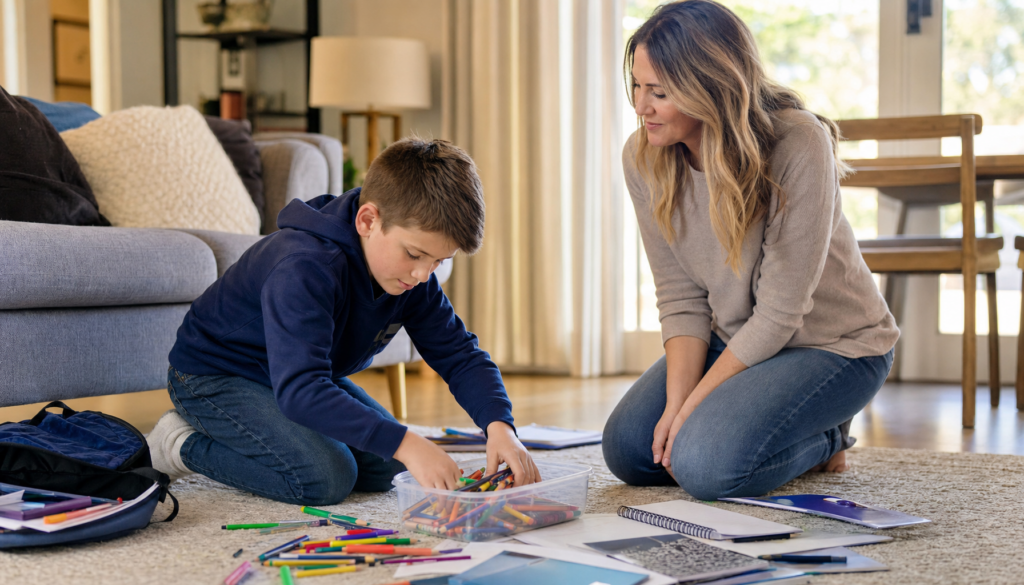
If craft supplies were left scattered across the floor, they can be put away before another activity begins.
If a library book is overdue, the child can participate in locating and returning it.
These are not punishments designed to make a child suffer.
They are reasonable next steps connected to what happened.
The objective is not:
“You made a mistake, so now something unpleasant must happen.”
It is:
“This happened. What needs to happen now?”
Teach Repair, Not Just Admission
Admitting a mistake matters.
But accountability does not necessarily end with:
“I did it.”
Often there is something that can be done next.
A drink spills.
Help clean it up.
Something belonging to a sibling is damaged.
Determine whether it can be repaired and what the child can appropriately do to help.
A child’s words hurt a friend.
Acknowledge what happened and consider how to repair the relationship.
A child does not complete their part of a shared project.
Determine what can still be done.
A useful question is:
“What can you do to help make this right?”
Sometimes children will know immediately.
Other times they will need options.
The purpose is not to make a child feel ashamed or force an elaborate apology.
It is to teach that mistakes often create a next responsibility.
An Explanation Doesn’t Erase Responsibility
Children often explain why something happened.
“I forgot because I was rushing.”
“I yelled because he took my toy.”
“I didn’t finish because I didn’t understand the directions.”
“I left my backpack because I thought Dad had already put it in the car.”
An explanation can be valid without eliminating whatever still needs to be addressed.
Parents can listen to the explanation.
Then ask:
“Given what happened, what do we need to do now?”
Perhaps the child really did misunderstand the assignment.
That matters.
The solution may include asking the teacher for clarification.
Perhaps the child became angry because a sibling took something without permission.
That matters too.
The sibling’s behavior can be addressed while the child still takes responsibility for yelling or pushing.
Children can learn that explaining what happened and accepting appropriate responsibility can happen at the same time.
Keep the Label Off the Child
A forgotten water bottle is a forgotten water bottle.
It does not need to become:
“You’re irresponsible.”
A messy desk does not require:
“You’re so careless.”
A forgotten task does not prove:
“You never think.”
Labels turn a specific problem into a statement about the child.
Instead, stay with what happened.
“The water bottle was left at home.”
“You agreed to feed the dog, and it hasn’t been done.”
“The toys were left outside.”
Then move forward:
“What needs to happen now?”
Or:
“What could help you remember next time?”
The conversation stays focused on something the child can actually address.
Let Kids Help Solve the Problem
Parents do not always need to provide the solution.
Ask the child.
“What do you think needs to happen?”
“How could you fix this?”
“What could help you remember next time?”
“What would make this easier to manage?”
Suppose a backpack is repeatedly forgotten.
The child might decide it needs a permanent location beside the door.
A recurring activity might be added to a checklist.
Sports equipment might be packed the evening before practice.
A household responsibility might be connected to something that already happens every day.
“Feed the dog after breakfast.”
The solution does not have to come entirely from the adult.
When children participate in solving recurring problems, responsibility becomes connected to planning and problem solving rather than simply following instructions.
Responsibility Also Means Knowing When to Ask for Help
Being responsible does not mean doing everything alone.
Sometimes the responsible action is:
“I don’t understand this.”
“I forgot what I’m supposed to do.”
“This is too heavy for me.”
“I made a mistake and I don’t know how to fix it.”
Children need to know that asking for appropriate help is different from handing the entire responsibility back to someone else.
A parent can help a child figure out how to organize the backpack without packing it every day.
A parent can help explain a household task without automatically completing it.
A child can ask for clarification on an assignment while still doing the work.
Knowing when help is needed is part of becoming more capable.
Gradually Transfer Ownership
Responsibility usually develops in stages.
At first, the adult may handle most of a task while the child watches.
Then they do it together.
Later, the child takes over while the adult provides reminders.
Eventually, the child may manage it independently.
Consider packing materials for an activity.
Initially, a parent might say:
“Let’s look at what you need and pack it together.”
Later:
“Check your list and pack your things. Let me know if you need help.”
Eventually:
“Are you ready for practice?”
The ownership has shifted.
This gradual transfer gives children practice without expecting instant independence.
Reminders are not necessarily evidence that responsibility has failed. They can be part of learning a new routine.
The goal is for those reminders to become less necessary as the child becomes more capable of managing the responsibility.
Keep Reflection Short and Useful
Not every mistake requires a long conversation.
Sometimes four questions are enough:
What happened?
What part was yours?
What needs to happen now?
What could help next time?
Then let the child act.
If the art supplies spilled, clean them up.
If the book was forgotten, return it.
If someone was hurt, work on repairing the situation.
If something keeps being forgotten, develop a better system.
Children do not necessarily need a lengthy speech to understand that something went wrong.
Often the most valuable part is participating in what happens next.
Responsibility for Kids Supports Growing Independence
As children grow, they naturally begin doing more without adults beside them.
They manage more belongings.
They make more choices.
They participate in activities away from home.
They handle increasingly complicated school expectations.
They want more freedom.
Responsibility and independence grow together.
A child who learns to keep track of belongings needs less adult supervision over those belongings.
A child who follows through on routines can manage more of those routines independently.
A child who recognizes mistakes and takes appropriate action needs an adult to solve fewer problems on their behalf.
This is not about making children earn every freedom through perfect behavior.
It is about gradually developing the skills required to manage greater independence.
Structured activities can also provide useful practice. A Responsibility and Accountability Workbook for Kids or Responsible Decision-Making Workbook for Kids can give children scenarios, reflection questions, and problem-solving activities that let them think through responsibility when they are not in the middle of an actual mistake.
The Most Useful Question May Be “What Now?”
Children will forget things.
They will make poor choices.
They will misunderstand instructions.
They will sometimes blame someone else.
They will occasionally need reminders for something you thought they had already learned.
Responsibility does not require eliminating those moments.
It changes what happens after them.
Instead of making every mistake an opportunity for a lecture, we can help children learn to ask:
What happened?
What part belongs to me?
What can I do about it?
What could I try differently next time?
Eventually, the parent does not have to supply every question.
The child begins recognizing the next step.
The overdue library book still needs to be returned.
But now the lesson is larger than the book.
The child is learning that when something goes wrong, they can acknowledge their part, repair what they can, ask for help when necessary, and decide what to do next.
That is responsibility in practice.