
Most parents can picture the milestones of independence.
The day a child finally ties their own shoes. The morning they remember everything they need for school without repeated reminders. The first time they solve a problem with a friend without immediately asking an adult to step in.
Those moments matter, but independence rarely arrives as one dramatic milestone.
It develops gradually through hundreds of ordinary opportunities to practice, make decisions, solve problems, experience manageable mistakes, and try again.
That makes independence less of a personality trait and more of a collection of skills.
Children gradually learn how to manage responsibilities, organize tasks, make decisions, solve problems, recover when something goes wrong, and recognize when they genuinely need assistance.
That last skill is especially important.
An independent child is not a child who never needs help. Healthy independence includes knowing when a problem can be handled alone and when asking someone for guidance is the sensible choice.
For parents, the challenge is finding the balance between providing enough support for children to succeed and enough space for them to develop their own capabilities.
Fortunately, parents do not have to make that transition all at once.
A much more practical approach is to move gradually from doing things for a child, to doing things with a child, to eventually allowing the child to take responsibility.
That gradual transition is at the heart of raising independent kids.
Raising independent kids does not mean expecting children to manage everything on their own.
The Hidden Ways Parents Can Slow Independence
Many of the habits that interfere with independence begin with perfectly reasonable intentions.
Imagine that the backpack is sitting near the door and a worksheet is still on the kitchen counter.
You remind your child once. Then again.
As the clock moves closer to departure time, it becomes much easier to pick up the worksheet and put it in the backpack yourself.
Problem solved.
Except the immediate problem and the long-term goal are not always the same thing.
Repeated reminders can gradually teach children to rely on someone else to manage the remembering. If a parent consistently functions as the family’s external alarm system, a child has fewer opportunities to develop routines and strategies of their own.
The same thing can happen with problem solving.
A child struggles with a zipper, school assignment, sibling disagreement, or household task. An adult can often solve the problem in seconds.
Sometimes stepping in is entirely appropriate. But when intervention becomes automatic, children lose opportunities to discover what they can accomplish themselves.
Parents can also become so focused on preventing mistakes that children have few opportunities to experience manageable consequences.
Some mistakes are serious and clearly require adult intervention. Others are relatively small: forgetting an ordinary school item, choosing mismatched clothes, spending saved money unwisely, or completing a household task imperfectly.
When the consequences are safe and reasonable, those experiences can become valuable teachers.
There is also the simple reality of time.
It is often faster to tie the shoes, pack the lunch, organize the backpack, or clean up the room yourself.
That does not make someone a poor parent. Families have busy mornings, difficult days, and circumstances when efficiency matters.
The question is whether helping has become the permanent default for something a child is ready to begin learning.
Recognizing that distinction gives parents an opportunity to change the pattern.
Support vs. Rescue: Finding the Right Balance
One of the challenges of raising independent kids is knowing when support becomes unnecessary intervention.
One of the most useful questions parents can ask is:
Am I supporting my child through this task, or am I taking ownership of the task away from them?
Support and rescue can look surprisingly similar from the outside.
Support means giving children the guidance, structure, encouragement, or assistance they need while allowing them to remain involved in solving the problem.
Rescue means routinely solving a manageable problem for them before they have a reasonable opportunity to work through it.
Consider something as simple as packing a school bag.
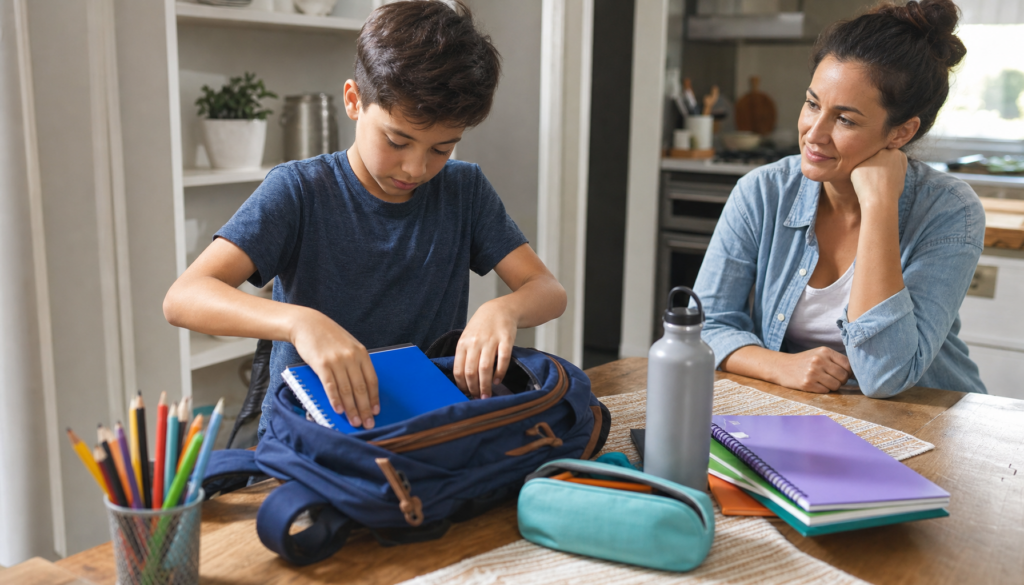
Instead of suddenly announcing that an eight-year-old is now completely responsible for remembering everything, a parent might begin by packing the bag together.
After the routine becomes familiar, the child packs while the parent watches.
Later, the child packs independently and uses a checklist.
Eventually, the parent no longer needs to participate.
Responsibility has been transferred gradually rather than abruptly.
This matters because independence without preparation can be just as unhelpful as excessive assistance.
Expecting children to manage responsibilities they have never been taught can leave them frustrated rather than empowered.
The goal is neither constant rescue nor a sink-or-swim approach.
The goal is the gradual transfer of responsibility.
A simple framework can make that process much easier.
The Independence Ladder: A Step-by-Step Method
Think of learning independence as climbing a four-rung ladder:
Demonstrate → Do Together → Supervise → Independent
Children can climb this ladder for all kinds of responsibilities, from packing a backpack to preparing a simple snack or organizing school materials.
Rung 1: Demonstrate
First, show the child how to complete the task.
Do not assume that something obvious to an adult is obvious to a child.
When appropriate, explain what you are doing and why.
For example, while preparing a school bag, you might explain how you check what is needed for the following day, place materials in the bag, and put the bag in its designated location.
The child is learning both the task and the thinking behind it.
Rung 2: Do Together
Next, complete the responsibility together.
The child should now participate rather than simply observe.
You might read the school checklist while the child finds the required items, or prepare a snack together while the child completes several of the steps.
The adult still provides guidance, but responsibility has begun to shift.
Rung 3: Supervise
Now the child performs the task while the adult remains available.
This can be the most difficult stage for parents because the temptation to correct every imperfection is strong.
If the task is safe and the outcome is acceptable, resist fixing details simply because you would have done them differently.
The goal at this stage is competence, not adult-level perfection.
Rung 4: Independent
Eventually, the child assumes responsibility for the task.
The parent remains available when genuinely needed but no longer manages the process.
And the ladder is flexible.
If a child struggles after moving to a higher rung, simply return temporarily to the previous one.
That is not failure.
It means the child needs additional practice before taking the next step.
Practical Ways to Build Independence at Home
Raising independent kids is a gradual process built through small, repeated opportunities to take responsibility.
The Independence Ladder becomes especially useful when it is applied to ordinary family life.
Parents do not need to create an elaborate independence program. Everyday responsibilities already provide plenty of opportunities.
Give Children Meaningful Responsibilities
Age-appropriate household responsibilities allow children to contribute to family life while developing practical skills.
Age-appropriate household responsibilities can also help children develop competence and contribute meaningfully to family life. The American Academy of Pediatrics offers additional guidance for parents on household chores and responsibility.
Younger children might sort laundry, put toys away, help set the table, or organize school supplies.
As children become more capable, responsibilities can become more complex.
The exact task matters less than choosing something the child can realistically learn and eventually manage.
Meaningful contribution also helps children understand that responsibility is not simply a collection of chores imposed by adults. Their effort contributes to the household.
Replace Repeated Reminders With Systems
If you find yourself repeating the same instructions every morning, consider creating a system that does some of the reminding.
A simple checklist might include:
Get dressed.
Brush teeth.
Eat breakfast.
Pack school materials.
Fill water bottle.
Put on shoes.
Instead of answering every “What do I need to do next?” question, parents can direct children back to the checklist.
The system gradually carries the routine while the child learns to manage it.
Allow Safe Imperfection
A child’s first attempt at a responsibility will rarely look like an adult’s version.
Laundry may not be folded perfectly.
A sandwich may look unusual.
The backpack may not be organized exactly the way you would organize it.
If the result is safe and functional, consider whether correction is really necessary.
Constantly redoing a child’s work can unintentionally communicate that their effort was inadequate.
Sometimes “good enough” is exactly what growing independence needs.
Teach a Simple Problem-Solving Process
When children encounter a problem, parents do not always have to provide the solution immediately.
Try asking:
What is the problem?
What are two or three things you could try?
Which one do you think you should try first?
How did it work?
Over time, these questions can become an internal process children use themselves.
The objective is not withholding guidance. It is teaching children how to think through manageable problems.
Offer Choices Within Reasonable Boundaries
Choice provides another opportunity to practice decision making.
Instead of an unlimited question such as “What do you want to do?” offer choices appropriate to the situation.
For example:
“Would you rather finish your homework before dinner or immediately after dinner?”
Both choices accomplish the necessary goal while allowing the child some ownership over the process.
What If They Forget, Fail, or Take Forever?
This is where building independence becomes difficult in real family life.
Children will forget things.
They will make mistakes.
And they will sometimes take far longer to complete a task than an adult would.
That does not mean the process is failing.
When They Forget
Before immediately fixing the situation, consider the consequence.
Is it dangerous, serious, or beyond what the child can reasonably manage?
If so, intervene.
But if the consequence is small and manageable, there may be value in allowing the experience to happen.
A forgotten library book or nonessential school item can become an opportunity to discuss what system might prevent the problem tomorrow.
The lesson is not simply, “You forgot.”
The more useful lesson is:
“What could you do differently next time?”
When They Take Too Long
Learning takes time.
A task that takes an adult thirty seconds may take a child several minutes while they are developing the skill.
Whenever possible, introduce new responsibilities during lower-pressure periods rather than during the busiest part of the morning.
Weekends, afternoons, and school breaks can provide better opportunities to practice before the task becomes part of a time-sensitive routine.
When They Do It Differently
Ask yourself whether the task was actually done incorrectly or merely differently from the way you would have done it.
That distinction matters.
If the result is safe and accomplishes the purpose, there may be no reason to redo it.
Children need room to develop their own methods as their competence increases.
Independence Without Emotional Distance
Some parents understandably worry that encouraging independence means becoming less involved in their child’s life.
It does not have to.
Practical independence and emotional connection can grow together.
A child can pack a backpack independently and still want to talk with a parent about a difficult school day.
A child can manage homework assignments and still seek advice when facing a challenging decision.
Strong independence also depends on communication. Children who learn to listen thoughtfully and communicate with others can become better equipped to ask for guidance when they need it and work through problems with other people.
A teenager can assume increasing responsibility while continuing to rely on family for guidance, encouragement, perspective, and connection.
The parent’s role changes as children develop.
When children are young, adults naturally do a great deal for them.
Over time, some of those practical responsibilities can move to the child while the parent’s emotional presence remains.
That distinction is important.
Parents are not withdrawing love or availability.
They are withdrawing unnecessary rescue.
Sometimes the most encouraging message a parent can communicate is simply:
“I think you can handle this. I’m here if you truly need me.”
That combination of confidence and availability gives children both room to grow and a secure place to return for guidance.
Signs You May Be Doing Too Much
It can be difficult to recognize when ordinary help has gradually become over-involvement.
Consider whether any of these patterns have become common:
You routinely complete responsibilities your child is capable of learning.
You repeatedly remind your child about the same task rather than helping them develop a system for remembering it.
You take over as soon as a task becomes frustrating.
You correct or redo work that was already acceptable.
You feel responsible for preventing nearly every mistake.
You are more concerned about a child’s responsibility than the child appears to be.
None of these automatically means something is wrong.
They are simply useful signals to examine.
The solution is not to withdraw all assistance suddenly.
Instead, choose one manageable responsibility and begin moving it up the Independence Ladder.
Try a 7-Day Independence Challenge
Choose one small responsibility that you currently manage but your child may be ready to begin owning.
It could be:
Packing a backpack.
Preparing school clothes.
Filling a water bottle.
Putting sports equipment in one place.
Setting the table.
Organizing homework materials.
Preparing a simple snack.
Then determine where your child currently belongs on the Independence Ladder.
Do they still need a demonstration?
Can you do it together?
Are they ready for supervision?
Or can they begin handling it independently with an appropriate system or checklist?
For seven days, focus on transferring a little more responsibility rather than simply completing the task for them.
If they struggle, ask what would help.
Perhaps they need a checklist, a designated storage location, additional practice, or another round of doing the task together.
The objective is not seven days of perfect performance.
It is seven days of practicing ownership.
Raising Capable Kids One Responsibility at a Time
Ultimately, raising independent kids means preparing children to handle more of life with confidence while knowing that support remains available when they truly need it.
There is no single moment when a child becomes independent.
Independence grows through ordinary experiences: tying a shoe, organizing school materials, completing a household responsibility, making a decision, solving a problem, recovering from a mistake, and knowing when to ask for help.
Parents play an essential role in that development.
But helping children become more capable does not necessarily mean doing more for them.
Sometimes it means changing how we help.
We demonstrate.
Then we do it together.
Then we supervise.
Eventually, we step back.
And when children struggle, we can move down a rung, provide additional guidance, and allow them to practice again.
Start with one responsibility this week.
Choose something your child is ready to begin managing and place it on the Independence Ladder.
The goal is not to make children need their parents as little as possible.
The goal is to help them become increasingly capable of handling the responsibilities they are ready to carry, while knowing that guidance, encouragement, and connection remain available when they need them.
That is independence worth building.