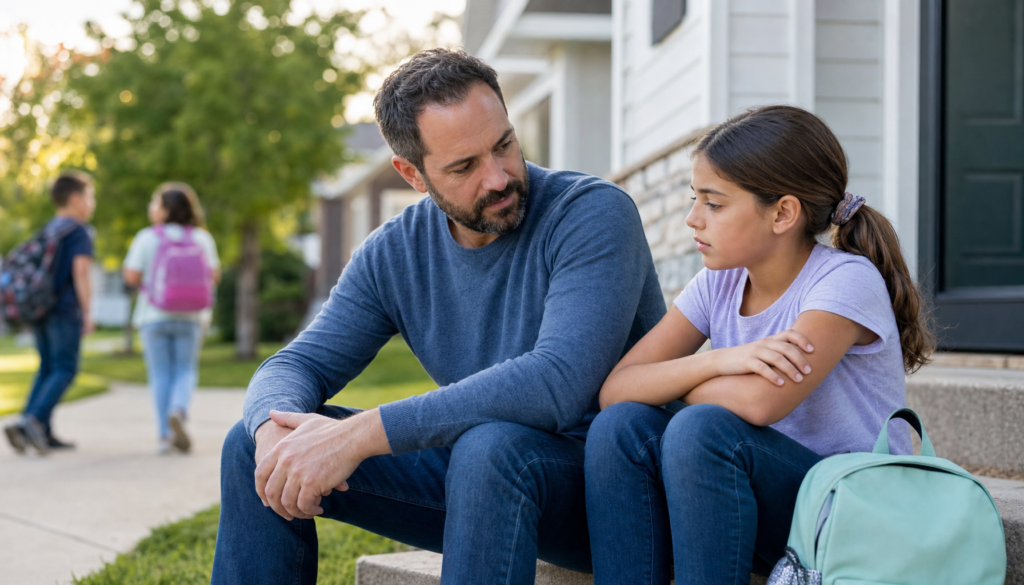
The car door barely closes before the tears start.
Your daughter tells you that her friend played with someone else at recess. She was left wondering whether her friend still likes her. By the time you pull away from school, one missed recess together has become, in her mind, evidence that the entire friendship may be falling apart.
For an adult, the situation may seem relatively small. For a child still learning how friendships work, it can feel enormous.
Wanting friends and knowing how to build and maintain friendships are two different things.
Children may genuinely want connection while still learning how to listen, compromise, join a group, handle disagreement, respect boundaries, apologize, and understand that friendships sometimes change.
These are friendship skills for kids, and they develop through experience, guidance, conversation, and practice.
That means the difficult moments matter too.
The playground disagreement, the friend who chooses someone else as a partner, the game nobody can agree on, and the comment that accidentally hurts someone’s feelings can all become opportunities to help children understand how relationships work.
The Real Skills Behind Healthy Friendships
We sometimes think friendship either happens naturally or it does not.
Children meet. They enjoy being together. A friendship forms.
But maintaining that friendship requires much more than simply liking someone.
A child may need to learn how to listen without interrupting, notice when another person wants a turn, compromise when two people want different things, recognize when a joke has gone too far, and repair a relationship after making a mistake.
These abilities do not necessarily develop at the same pace.
A child who always wants to choose the game may need more practice with give-and-take. A child who frequently interrupts may still be learning how to show interest while someone else speaks. A child who becomes upset whenever a friend plays with someone else may still be learning that friendships do not require exclusivity.
Instead of turning these behaviors into labels, parents can identify the skill that needs more practice.
Rather than thinking, “My child is bossy,” consider, “My child needs more practice compromising.”
Instead of, “My child is bad at making friends,” consider which part of the process is difficult.
Is it approaching other children? Listening? Handling rejection? Managing disagreement? Understanding boundaries?
Once the specific difficulty becomes clearer, it becomes much easier to practice.
Help Kids Learn How to Join In
Joining a conversation or activity already in progress can be surprisingly complicated.
A child sees two other children building something and wants to participate. Walking directly over and demanding a role may not work. Standing nearby hoping someone notices may not work either.
Children can learn to observe first.
What are the other children doing?
Is there a natural way to contribute?
Instead of simply asking, “Can I play?” a child might say:
“That tower is huge. Can I help find more blocks?”
Or:
“Do you need another person on your team?”
The exact words matter less than the underlying skill. The child is learning to notice what is happening before entering the situation.
Children also need to know that sometimes the answer will be no.
That can hurt, but a single no does not necessarily mean nobody likes them. The other children may already be finishing something, may have established teams, or may simply want to continue what they are doing.
Learning how to handle that disappointment and try something else is part of developing friendship skills too.
Listening Helps Friendships Grow
Friendship is not only about knowing what to say.
Children also need to learn how to show interest in what someone else is saying.
Consider a child whose friend starts talking about a new puppy. The child immediately interrupts with a story about their own dog.
That response is understandable. The child is trying to connect through a shared experience.
But there is another skill to learn: allowing the other person’s story to continue.
A parent might practice this during ordinary family conversations:
“Let’s hear the rest of the puppy story first. What could you ask about it?”
Children can learn to ask questions, wait for an answer, and notice when another person wants to speak.
Listening is one of the most useful friendship skills for kids because it communicates something simple but important:
What matters to you matters to me too.
Friendship Requires Give-and-Take
Two children want to play different games.
One wants tag. The other wants to build with blocks.
This small disagreement contains an important friendship lesson.
Healthy relationships require flexibility.
Sometimes one child chooses. Sometimes the other does. Sometimes they find a third option. Sometimes they divide their time between both activities.
Parents do not always need to determine the solution.
Instead, ask:
“You both want something different. What could you do?”
Children may surprise you with their solutions.
They might agree to play one game first and the other later. They might combine ideas. They might decide that each person gets to choose on alternating days.
The objective is not to make every interaction perfectly equal.
It is to help children understand that friendship cannot consistently revolve around one person’s preferences.
Disagreement Does Not Mean a Friendship Is Over
Children sometimes treat conflict as evidence that a friendship has ended.
“She isn’t my friend anymore.”
“He was mean to me.”
“We’re never playing together again.”
Sometimes those statements reflect a serious problem. Often, however, they are reactions to an ordinary disagreement that feels enormous in the moment.
Children can learn that people who like each other still disagree.
They can also learn simple ways to work through those disagreements.
“I was upset when you changed the rules.”
“I thought it was my turn.”
“What did you mean when you said that?”
“Can we start over?”
The goal is not to give children a perfect conflict-resolution script. It is to show them that disagreement can lead to conversation rather than automatically ending a relationship.
That distinction becomes increasingly valuable as friendships grow more complicated.
Boundaries Are Part of Being a Good Friend
Being a good friend does not mean agreeing to everything.
Children need permission to say no.
“I don’t want to play that game.”
“Please don’t call me that.”
“I don’t want you to share that picture.”
“I need some space right now.”
They also need to learn to respect those same boundaries when another child expresses them.
If a friend does not want to lend something, participate in an activity, be hugged, or continue a joke, respecting that answer is part of friendship.
Teasing can provide an especially useful lesson.
A child may insist, “I was only joking.”
A helpful question is:
“Did the other person think it was funny?”
Intent matters, but so does impact.
Children can gradually learn to notice when another person is uncomfortable and adjust their behavior accordingly.
A Good Apology Is About Repairing the Relationship
Children are often told to say sorry immediately after doing something wrong.
Sometimes the words come out before the child has even thought about what happened.
A more meaningful apology begins with understanding.
What did I do?
How did it affect the other person?
What can I do now?
A child might say:
“I grabbed your toy without asking. I know that upset you. Can I give it back?”
Or:
“I shouldn’t have said that about you. I understand why you’re angry.”
Children do not need to memorize an elaborate apology formula.
They need to understand that apologizing is not simply saying a required word. It is acknowledging what happened and, when possible, helping repair the situation.
Friendships Can Change Without Someone Being Wrong
Not every friendship ends with an argument.
Sometimes children simply begin moving in different directions.
One becomes interested in sports while another prefers art. One develops new friendships. Children change classes, activities, schools, or interests.
A friendship that once seemed inseparable may gradually become less important.
That can be difficult for a child to understand.
Parents can acknowledge the disappointment without automatically searching for someone to blame.
“You and Zoe may be interested in different things right now. That doesn’t mean either of you did something wrong.”
Some friendships last for years. Others belong to a particular season of childhood.
Learning how to accept those changes while remaining respectful is another relationship skill children gradually develop.
Know When to Coach and When to Step In
Watching your child struggle socially can make it tempting to solve the problem.
Sometimes intervention is necessary.
But ordinary friendship difficulties can also provide children with valuable opportunities to develop their own judgment.
Parents can begin by listening.
“What happened?”
“How did that make you feel?”
“What do you think your friend was feeling?”
“What could you try tomorrow?”
“What would you like to happen next?”
Questions like these allow parents to provide support without immediately taking control of the situation.
There are important exceptions.
Bullying, threats, harassment, safety concerns, repeated mistreatment, or situations a child cannot reasonably manage alone require adult attention.
Ordinary disagreement and persistent harmful behavior are not the same thing.
When children are working through normal friendship problems, parents can often coach from nearby.
When children are being harmed or need protection, adults should step in.
Practice Friendship Skills Before the Difficult Moments
Friendship skills become stronger through use.
Role-playing is one simple way to practice.
A parent can pretend to be another child who says no to a game. The child practices responding.
Then switch roles.
Practice asking to join an activity.
Practice telling someone to stop an uncomfortable joke.
Practice what to say after accidentally hurting someone’s feelings.
Stories, television programs, and everyday observations can also create opportunities.
When a character gets left out, ask:
“What do you think they could try?”
When two characters argue:
“What could they have done differently?”
These conversations allow children to think about relationships without the emotional pressure of being directly involved.
Structured activities can provide another way to practice. A Friendship & Relationship Skills Workbook can give children scenarios, questions, and activities that help them explore friendship situations before encountering similar challenges themselves.
The objective is not to drill children on the “correct” way to make friends.
It is to give them opportunities to think, practice, and build confidence.
Friendship Skills for Kids Grow With Practice
Children do not need enormous social circles to develop healthy relationships.
One or two meaningful friendships may be far more valuable to a child than being surrounded by a large group.
What matters is learning how relationships work.
Listen when someone else speaks.
Make room for another person’s preferences.
Respect boundaries.
Handle disagreement without assuming everything is over.
Apologize when you have caused hurt.
Recognize when a friendship is changing.
Ask for help when a situation becomes more than you can handle.
These abilities develop gradually.
There will be playground disagreements, hurt feelings, awkward attempts to join groups, arguments over games, and friendships that change.
Those moments do not mean a child has failed at friendship.
They are often where the learning begins.