
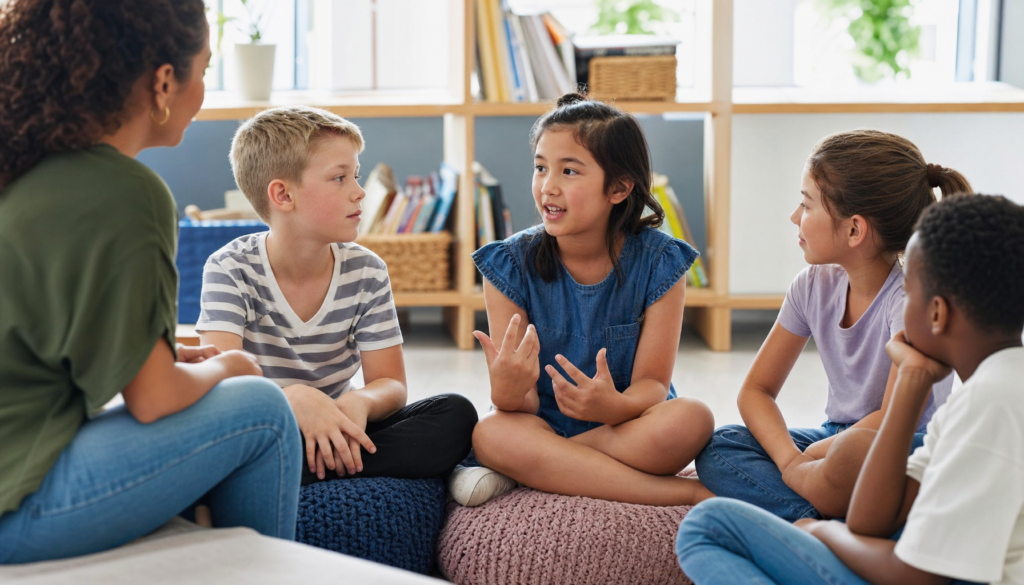
Listening skills for kids affect far more than whether children follow directions the first time. Listening helps children understand what they are learning, participate in conversations, work with others, develop friendships, and communicate more effectively at home and at school.
Yet hearing someone speak and truly listening are not the same thing.
A child may look toward a parent or teacher and still miss part of the message. Another may hear every word but struggle to remember the instructions long enough to act on them. Some children become distracted easily, while others are so eager to respond that they begin thinking about what they want to say before the other person has finished.
These are not simply matters of being “good” or “bad” listeners. Listening involves attention, comprehension, memory, self-control, and practice.
The encouraging part is that children can strengthen these skills over time.
Why Listening Skills for Kids Matter
Listening is an active process.
Children need to pay attention to what is being said, make sense of the message, hold important information in mind, and decide how to respond.
That combination makes listening important across many areas of a child’s life.
In the classroom, listening helps children follow directions, understand explanations, participate in discussions, and recognize important information.
At home, it supports smoother communication between children and adults.
With friends, listening allows children to understand another person’s ideas and feelings rather than concentrating only on what they want to say next.
Strong listening also supports independence. A child who understands instructions and remembers important details needs fewer reminders and can take greater responsibility for completing tasks.
Help Children Understand the Difference Between Hearing and Listening
One useful starting point is helping children understand that being quiet does not necessarily mean they are listening.
Hearing happens naturally when sound reaches us. Listening requires attention.
A child can sit silently while thinking about something completely unrelated to the conversation. Another child might appear restless but still understand exactly what was said.
Instead of focusing only on outward behavior, help children recognize what active listening actually involves.
After giving an instruction, you might ask:
What did you hear me ask you to do?
Or:
Can you tell me that in your own words?
This is different from asking, “Were you listening?”
Most children will simply answer yes.
Asking them to explain the message gives both of you useful information about what was actually understood.
Strengthen Listening Through Everyday Conversation
Children have frequent opportunities to practice listening during ordinary family conversations.
Instead of turning every interaction into a lesson, make room for genuine back-and-forth conversation.
Ask questions that require more than a one-word answer.
What was the most interesting thing that happened today?
Why do you think that happened?
What did your friend say after that?
Then model the same listening behavior you want children to develop.
Allow them to finish speaking. Ask a relevant follow-up question. Refer to something they said earlier.
Children gradually learn that conversation is not simply taking turns making statements. Good communication requires paying attention to another person’s meaning.
Teach Children to Pause Before Responding
Some listening problems occur because children are preparing their response while someone else is still talking.
They may hear the beginning of the message and immediately start thinking about what they want to say.
A simple pause can help.
Encourage children to wait for a moment after someone finishes speaking before responding. The pause does not need to be long. Even a second or two gives them an opportunity to process what they heard.
Parents can model this as well.
When a child asks a question or explains a problem, resist the urge to respond immediately. A brief pause communicates that you are considering what the child said.
Over time, children can begin to associate listening with understanding first and responding second.
Use Repeat-Back to Check Understanding
Repeat-back is one of the simplest ways to strengthen listening skills for kids.
Suppose you say:
“Please put your shoes in the closet, take your backpack upstairs, and then wash your hands.”
Instead of asking whether the child understands, ask:
What are the three things you’re going to do?
This allows the child to practice holding spoken information in mind and organizing it.
If three steps are too difficult, reduce the number.
The purpose is not to catch children making mistakes. It is to discover how much spoken information they can comfortably manage and then build from there.
Repeat-back is especially useful for instructions involving several steps.
Make Listening More Manageable
Adults sometimes give children more verbal information than they can reasonably process at once.
A long explanation may include several instructions, background information, reminders, and corrections all in one conversation.
Breaking information into manageable pieces can make listening easier.
Instead of:
“Go upstairs, change your clothes, put your school things away, remember that we have to leave at five, and don’t forget the permission slip I told you about this morning.”
Try giving the most immediate instruction first.
Once that is completed, move to the next.
As children become more capable of managing multi-step instructions, gradually increase the amount of information they are expected to remember.
This helps build capacity without turning every conversation into a memory test.
Practice Listening Without Making It Feel Like Work
Listening practice can easily become part of games and family activities.
Simon Says is a classic example because children must pay close attention to spoken directions before acting.
You can make the game progressively more challenging by introducing two-step or three-step directions.
Storytelling works too.
Tell a short story and afterward ask questions such as:
Where did the story happen?
What problem did the character have?
What happened first?
What do you think might happen next?
Audio stories can provide another useful form of practice because children must follow the story through spoken language rather than relying primarily on pictures.
The objective is not to quiz children constantly. It is to give them enjoyable opportunities to discover that careful listening helps them understand more.
Listening Supports Learning in the Classroom
Listening becomes especially important as children progress through school.
Teachers explain concepts, provide directions, ask questions, lead discussions, and introduce information that may not appear exactly the same way in a textbook or worksheet.
Children therefore need to identify what matters while they listen.
This connects listening with other learning habits, including note-taking, organization, memory, and concentration.
A student taking notes, for example, cannot simply write every word a teacher says. The child must listen, recognize an important idea, and decide how to record it.
That is a complex learning task.
Children who are developing stronger study habits can benefit from practicing these skills together rather than treating listening, memory, organization, and studying as completely separate abilities.
Our guide to study skills for kids offers additional strategies for developing these broader learning habits.
Help Children Listen for Meaning, Not Just Words
Good listeners do more than remember exact sentences.
They try to understand what another person means.
Suppose a friend says:
“I didn’t really want to play that game anyway.”
The words communicate one message, but tone of voice and facial expression might suggest disappointment.
Children gradually learn to notice these additional signals during conversation.
You can encourage this by occasionally asking:
How do you think that person felt?
What made you think that?
Did their voice match what they were saying?
This type of conversation helps children recognize that communication includes words, tone, expression, and context.
Listening Is an Important Friendship Skill
Children naturally want to be heard.
Learning to offer that same attention to someone else is an important part of friendship.
Helping children practice attentive listening can also support empathy and stronger relationships with others.
A child who listens can learn what a friend enjoys, recognize when something is bothering them, remember things that matter to them, and respond more thoughtfully.
Listening also makes disagreements easier to navigate.
Children sometimes argue about something they think another person said rather than what was actually meant.
Teaching them to clarify before reacting can help.
Useful phrases include:
Do you mean…?
Are you saying that…?
Can you explain that again?
These simple questions encourage children to seek understanding before assuming they already know what another person meant.
Create Conditions That Make Listening Easier
Sometimes the problem is not the child’s willingness to listen. The environment simply makes listening difficult.
Background television, multiple conversations, devices, music, and activity can compete for attention.
When something is important, reducing unnecessary distractions can help.
That does not mean children require complete silence for every conversation. It means recognizing that some messages deserve more focused conditions.
You might turn off the television before giving several instructions or move closer to a child rather than calling directions from another room.
Timing matters too.
A child who has just walked through the door after a demanding school day may not be ready to absorb a long list of questions and instructions immediately.
Good communication involves considering not only what we say but also when and how we say it.
Adapt Listening Expectations to the Child
Children develop at different rates, and listening expectations should reflect their age and individual abilities.
Younger children generally benefit from shorter instructions, simpler language, and opportunities to repeat what they heard.
Older children can gradually manage more complex conversations and instructions, but they may still struggle when tired, distracted, frustrated, or emotionally overwhelmed.
Some children also process spoken information differently.
If a child consistently struggles to understand spoken directions despite appropriate practice and support, parents may want to discuss the pattern with the child’s teacher or an appropriate health or educational professional.
The purpose is not to attach a label to every listening difficulty. It is to recognize when a child may need support beyond ordinary practice.
Avoid Turning Listening Into Constant Correction
If every conversation about listening begins with:
“You never listen.”
children may begin to see listening as another area where they continually fail.
Specific feedback is more useful.
Instead of:
“You weren’t listening again.”
Try:
I gave you three directions, but it looks like you remembered the first one. Let’s try the other two again.
Or:
You waited until your sister finished before answering. That helped you understand what she was trying to say.
Specific observations show children what successful listening actually looks like.
They also make improvement easier to recognize.
Build Listening Skills Through Real Responsibilities
Everyday responsibilities provide natural opportunities for children to practice listening.
Cooking is a good example.
A child may need to listen to a sequence of steps, remember quantities, ask questions when something is unclear, and recognize when the next instruction depends on completing the previous one.
Games, crafts, household projects, sports, and family outings can provide similar opportunities.
The advantage of these situations is that listening has a purpose.
Children are not practicing a skill simply because an adult says they should. They are listening because understanding the information helps them accomplish something they care about.
Help Children Become Curious Listeners
One of the strongest listening habits is curiosity.
A curious listener does not merely wait for another person to stop talking.
They want to understand more.
Teach children to ask follow-up questions.
If a friend says they visited their grandparents, the conversation does not have to end with “That’s nice.”
A child might ask:
What did you do there?
How long did you stay?
What was your favorite part?
Follow-up questions demonstrate that the listener heard what was said and is interested enough to continue the conversation.
This can be practiced at the dinner table, during car rides, or in family conversations.
When Listening Difficulties Persist
Occasional distraction is normal.
However, persistent difficulty understanding spoken information may deserve closer attention, particularly when it affects school, relationships, or everyday functioning.
Listening difficulties can have many possible explanations. Hearing, attention, language processing, learning differences, stress, and other factors may influence how easily a child follows spoken information.
Parents do not need to determine the cause themselves.
If concerns persist, begin by talking with the child’s teacher and appropriate health or educational professionals. Comparing what happens at home and at school can help identify whether the difficulty occurs across different environments.
Early conversations can provide useful information and help determine whether additional support is appropriate.
Frequently Asked Questions
At what age can children begin developing listening skills?
Listening develops from very early childhood, but expectations should change as children grow. Young children can practice following simple directions, taking conversational turns, listening to short stories, and answering questions about what they heard. More complex listening skills can develop gradually as language, attention, and memory mature.
How can I tell whether my child is really listening?
Instead of relying only on eye contact or stillness, ask the child to explain what they heard in their own words. A child who can summarize the message, answer an appropriate question, or carry out the instruction demonstrates understanding more clearly than one who simply appears attentive.
Should children always make eye contact while listening?
No. Eye contact can be one signal of attention, but it should not be treated as proof that a child is listening. Some children listen effectively without sustained eye contact. Understanding and appropriate response are more useful measures.
Can games improve listening skills?
Yes. Games involving spoken directions, storytelling, sequencing, clues, and conversation can provide enjoyable listening practice. The most useful activities require children to pay attention to meaning rather than simply remain quiet.
What should I do when my child repeatedly forgets verbal instructions?
Start by shortening the instructions and asking the child to repeat them back. Gradually increase complexity as the child becomes successful. Visual reminders can also complement spoken instructions. If significant difficulty persists across different situations, discussing the concern with the child’s teacher or another appropriate professional may be useful.
Start With Better Conversations
Improving listening skills for kids does not require turning the home into a classroom.
Start with conversation.
Give children time to finish their thoughts. Ask follow-up questions. Reduce distractions when something important needs to be communicated. Ask children to repeat multi-step instructions. Encourage them to clarify something they do not understand.
Most importantly, model the kind of listening you want them to develop.
Children learn a great deal about communication by experiencing what it feels like when another person gives their words genuine attention.
One better conversation at a time can help children become more thoughtful listeners, clearer communicators, and more confident participants in learning, friendships, and everyday life.