
Why Characters Give Kids a Place to Start
You hand your child a blank sheet of paper and say, “Let’s write a story.” Their pencil hovers.
They look at the ceiling. Then comes the question that stops everything:
“About what?”
It’s not necessarily that they don’t have ideas. Sometimes they have too many decisions to make at once.
What’s the setting? Who’s in the story? What happens first? Is it funny, mysterious, adventurous, or something else?
That’s a lot to decide before writing a single word, and it can make getting started difficult.
That’s where character creation for kids can help.
Instead of inventing an entire story at once, children can begin by inventing one person. Or one talking cat. Or one robot with a leaky oil can.
A single character gives them something concrete to work with.
Once your child knows who the character is, what they look like, what they enjoy, and what bothers them, story possibilities begin to appear.
The character can walk into a situation, encounter a problem, meet someone, make a choice, or discover something unexpected.
You don’t have to explain all of that to your child.
Instead, ask:
“Who would be interesting to follow on an adventure?”
That question feels much more like imagination than an assignment.
Once the character exists, your child is no longer starting with an empty page. They already have someone whose story they can begin discovering.
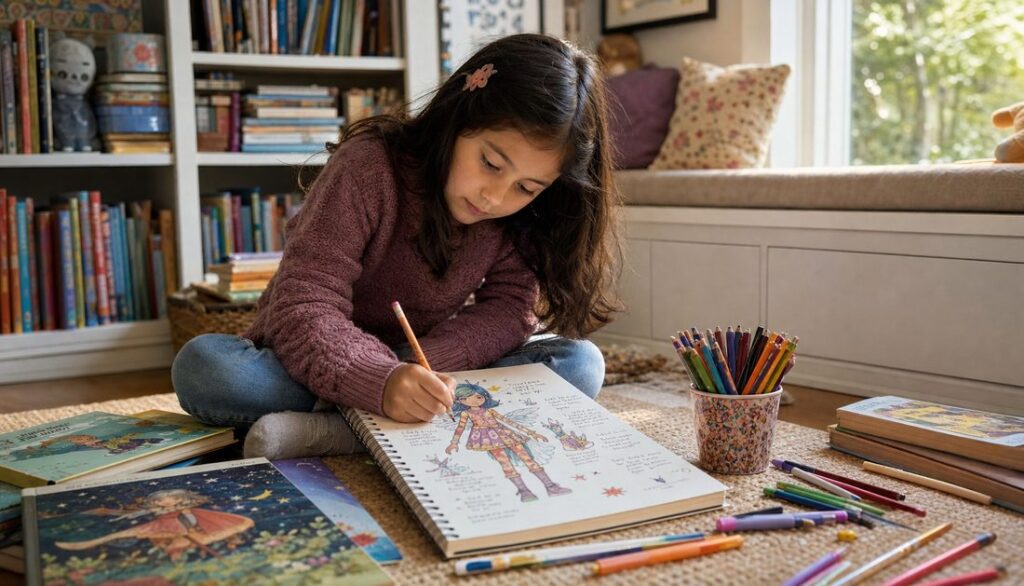
Character Creation for Kids Can Start With a Picture
Set the writing pencil aside for a moment and pick up colored pencils, crayons, or markers.
Drawing a character first can remove some of the pressure that comes with immediately trying to write a story.
There’s no paragraph to construct and no sentence to perfect. There’s simply a blank page and a character beginning to take shape.
Maybe it’s a girl with enormous boots and a tiny umbrella.
Maybe it’s a robot built from a toaster and spare bicycle parts.
Perhaps it’s a fox wearing a patched coat, a wizard with mismatched shoes, or a knight with a tiny scar above one eyebrow.
Those visual details create questions.
Why is the fox’s coat patched?
Who fixed it?
Where did the wizard’s other shoe go?
How did the knight get that scar?
What happened that day?
As children answer questions about their drawings, they begin generating material they can use in a story.
The drawing becomes a bridge between imagining a character and telling what happens to that character.
Some children may want to spend considerable time drawing before they write anything. That’s fine. The visual exploration is part of developing the idea.
Once the character exists on the page, you can move to another useful question:
“What does this character want?”
Children who enjoy bringing original characters to life can continue exploring with Character Creator! Design Workbook for Kids, which provides structured opportunities to develop character appearances, personalities, traits, ideas, and imaginative details.
Give Your Character Something They Really Want
Once your child has created a character, ask:
“What does your character want more than anything right now?”
That question can transform a drawing into the beginning of a story.
Maybe the little fox wants to find a warm place to sleep for the winter.
Maybe the toaster robot wants to learn how to make real toast instead of just pretending.
Maybe the girl with the enormous boots wants to win the town’s annual strawberry pie contest.
Once the character wants something, you can ask another question:
“What could get in the way?”
The fox can’t find a warm den because a grumpy badger already lives in the best cave.
The robot’s toaster parts keep shorting out during practice.
The girl keeps burning her pie because the oven doesn’t work properly.
Now there is a problem to solve.
That leads naturally to choices.
Does the fox negotiate with the badger?
Does the robot search for another power source?
Does the girl find somewhere else to bake her pie?
You don’t need to introduce formal storytelling terms to explore these ideas.
Just keep asking what the character wants, what gets in the way, and what the character decides to do about it.
Those questions can gradually reveal a beginning, a problem, a series of choices, and an ending.
Ask Questions Instead of Giving Instructions
There’s an easy trap to fall into when helping a child create a character.
Adults start supplying the ideas.
“You should give her a pet.”
“Maybe make him brave.”
“Why don’t you add a secret?”
The suggestions are well intentioned, but too many of them can gradually turn the child’s character into the adult’s creation.
Instead, ask questions.
Open-ended questions give children room to decide who their character is.
Try:
“What would completely ruin your character’s day?”
“What is your character really good at?”
“What does your character always carry in a pocket or backpack?”
“Who would your character want as a best friend?”
“What makes your character nervous?”
“What is something your character would never want to do?”
“What does your character do when nobody else is around?”
“What would make your character laugh?”
The answers create details that can later become part of a story.
If your child says the character always carries a mysterious key, ask:
“What does the key open?”
If the character is terrified of frogs, ask:
“What would happen if there were frogs everywhere?”
If the character secretly knows how to fly, ask:
“Who knows about it?”
Your job doesn’t have to be supplying the story.
Sometimes the most useful thing you can do is listen and ask the next interesting question.
Drop Your Character Somewhere Unexpected
Once your child knows the character fairly well, change something.
Put the character somewhere they wouldn’t normally belong.
A pirate walks into a public library.
A shy dragon attends a birthday party.
A detective arrives at a school carnival.
A cowboy goes to a ballet recital.
A mermaid somehow ends up in a desert.
The mismatch immediately creates questions.
Why is the pirate in the library?
What happens when the shy dragon is introduced to everyone at the party?
Why does the detective think something suspicious is happening at the carnival?
How is the mermaid going to handle being surrounded by sand?
Your child already knows the character, so they don’t have to invent everything from scratch.
They can simply ask:
“What would my character do here?”
You can repeat the activity with the same character and several different settings.
One character might generate an entire collection of completely different stories.
Let Characters Have Flaws and Make Mistakes
Children sometimes assume that the hero of a story needs to be brave, clever, kind, and good at everything.
But characters can become much more interesting when something about them makes life complicated.
Perhaps the detective is terribly forgetful.
The knight is afraid of horses.
The wizard is impatient.
The explorer refuses to admit when she is lost.
The superhero can fly but gets distracted whenever someone mentions pizza.
These imperfections create possibilities.
A forgetful detective might misplace the most important clue.
A knight afraid of horses has an obvious problem when everyone expects him to ride one.
An explorer who refuses to admit she is lost might lead everyone in the wrong direction.
Mistakes can also change what happens next.
Ask:
“What choice could your character make that causes another problem?”
Then:
“What will they do about it?”
Characters don’t need to make perfect decisions. Sometimes their mistakes are what keep the story moving.
From Character to Story Without the Pressure
At this point, your child has a character.
The character wants something.
Something gets in the way.
Now you have the beginnings of a story.
A simple framework is:
Character → Want → Problem → Choice → What Happens Next
The character wants something.
Something creates a problem.
The character chooses what to do.
That choice causes something else to happen.
Then you ask:
“What happens next?”
There’s no need to turn this into a formal lesson about plot structure. The questions themselves can guide the storytelling.
And storytelling doesn’t have to begin with writing.
A child might tell the story aloud while you listen.
They might act it out with stuffed animals.
They might create a comic strip.
They could draw several scenes and explain what is happening in each one.
They might dictate the story while an adult writes or types it.
They could even pretend to interview their character and answer the questions in character.
Writing is one way to capture a story, but it doesn’t have to be the first step.
Creative projects can also become easier when children have a simple starting point and permission to experiment. Our article Why Game Design for Kids Is More Than Just Playing explores another way children can turn their own ideas into something they can create, test, and develop.
The Bigger Goal: Helping Kids Discover Their Own Stories
Character creation gives children a manageable place to begin.
Instead of asking them to invent an entire story at once, you’re giving them one interesting question:
“Who is this?”
From there come more questions.
What do they want?
What are they afraid of?
Where are they going?
Who will they meet?
What problem will they encounter?
What choice will they make?
What happens next?
One answer leads naturally to another.
And somewhere along the way, that character who began as a few pencil lines on a page starts having adventures.
That’s the opportunity behind character creation for kids.
Children don’t have to begin with a perfect sentence, a detailed outline, or even a written paragraph.
They can begin with a face, a funny pair of shoes, a mysterious object, an unusual habit, or one simple idea.
Then they can follow that character and discover where the story goes.