It can happen before the day has really begun.
“Backpack by the door.”
“Did you remember your water bottle?”
“Where are your library books?”
“Is your permission slip in your bag?”
After several reminders, everything may eventually make it into the car, but the adult has done most of the remembering.
This is one of the challenges of teaching kids responsibility. Parents naturally want mornings to run smoothly, important belongings to make it to school, pets to be fed, and household jobs to get done. Reminding a child can seem faster and easier than waiting to see whether they remember independently.
But there is an important difference between completing a task after repeated reminders and learning to take ownership of it.
A child who puts away their shoes after being asked several times has completed the task. A child who comes inside, notices where the shoes belong, and puts them away without prompting has taken another step toward managing the responsibility.
That kind of follow-through develops gradually.
The goal is not to stop helping children. It is to slowly transfer more of the remembering, starting, completing, and checking to them as they become ready.
What Responsibility Really Looks Like
Follow-through may look like one skill, but several things have to happen for a child to manage a responsibility independently.
A child needs to:
- Know what needs to be done.
- Remember that it needs to be done.
- Start the task.
- Complete all parts of it.
- Check that it is actually finished.
Breaking responsibility into these parts helps adults identify where a child may be getting stuck.
Some children understand exactly what needs to happen but forget.
Others remember but have trouble getting started.
Some begin enthusiastically and leave the final steps unfinished.
Others complete the task but never stop to check their work.
Consider the instruction:
“Clean your room.”
An adult may know exactly what that means, but a younger child may not.
Where should they start? What counts as clean? How will they know when they are finished?
Compare that with:
“Put the dirty clothes in the hamper, return the books to the shelf, and put the toys in their bins.”
Now there is a clear finish line.
Clear expectations make it easier for children to manage a responsibility because they understand what completion actually looks like.
Why Parents Become the Family Reminder System
Parents rarely set out to remember everything for everyone.
It happens gradually.
A child forgets a water bottle, so the parent reminds them the next morning.
The backpack is left in the bedroom, so the parent asks about it before leaving.
Sports equipment is forgotten once, so someone begins checking for it before every practice.
Soon the adult is keeping track of backpacks, homework folders, water bottles, library books, sports equipment, pet care, chores, appointments, and tomorrow’s special school activity.
The system works because the adult remembers.
But that can also mean the child gets fewer opportunities to practice remembering.
The solution is not to suddenly stop helping and allow every forgotten responsibility to create a problem. Instead, begin transferring parts of the remembering process gradually.
Teaching Kids Responsibility by Gradually Stepping Back
Think of responsibility as something transferred in stages.
A simple progression might look like this:
Adult remembers and tells → Adult asks → Child uses a cue or checklist → Child remembers → Child checks their own work
Suppose the responsibility is putting shoes away after coming inside.
At first, you might say:
“Put your shoes in the closet.”
Later, instead of giving the answer, ask:
“Where do your shoes belong?”
Eventually, a visual cue near the entryway might replace your question.
After enough repetition, the child may begin putting the shoes away without either the reminder or the cue.
The final step is self-checking. The child notices whether the responsibility has actually been completed.
This progression does not need to happen quickly.
Children may manage one responsibility independently while still needing support with another. They may also temporarily need more help when routines change.
The goal is gradual transfer, not immediate independence.
Replace Repeated Reminders With Useful Systems
One of the easiest ways to reduce verbal reminders is to move the reminder outside the parent.
Instead of repeatedly telling a child what to remember, create a simple system they can learn to use themselves.
Use a Short Checklist
A morning checklist might include only the essentials:
- Backpack
- Lunch
- Water bottle
- Jacket
- Activity equipment
An evening checklist might include:
- Homework in backpack
- Lunchbox emptied
- Clothes ready
- Needed materials by the door
Keep lists short enough to be useful.
A checklist containing twenty items can become another overwhelming task rather than a support.
Give Important Things a Home
Designated locations reduce the amount children need to figure out each time.
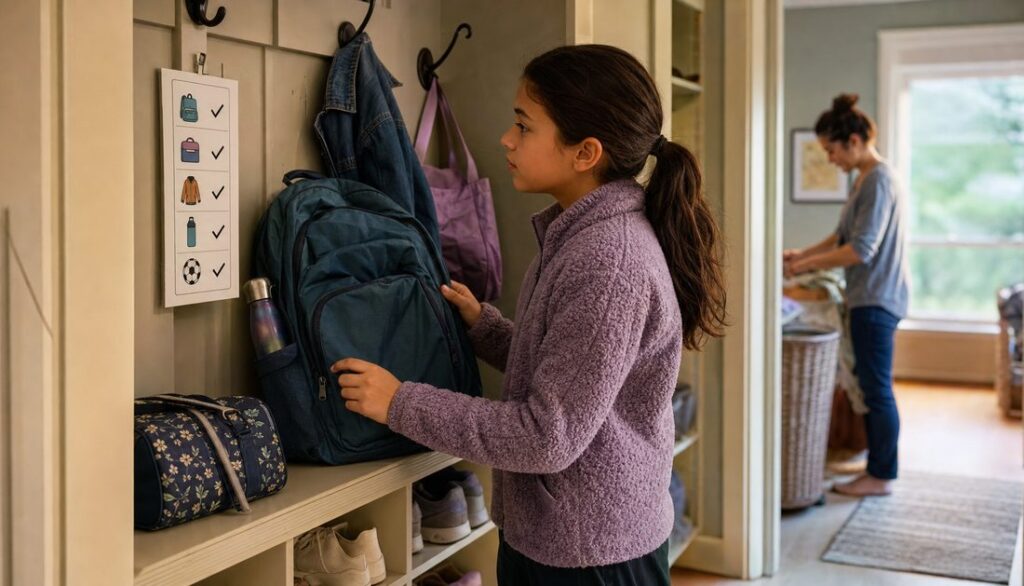
Backpacks always go on the same hook.
Shoes go in the same cubby.
Sports equipment goes in the same bin.
Library books wait in the same location when they need to be returned.
The environment itself begins providing part of the reminder.
Connect Responsibilities to Existing Routines
A task can be easier to remember when it follows something that already happens consistently.
Feed the pet after breakfast.
Put the backpack by the door after homework.
Place dirty clothes in the hamper before getting into pajamas.
Check tomorrow’s supplies after dinner.
The existing routine becomes the cue.
Use Visual Reminders
Younger children may benefit from pictures or simple symbols rather than written instructions.
A picture near the door can remind a child what needs to leave the house.
A visual sequence can show the steps in an evening routine.
The important point is that the child learns to consult the system rather than waiting for the adult to supply every reminder.
What to Say Instead of Repeating the Same Command
Changing the language you use can return some of the thinking to the child.
Instead of:
“Get your backpack.”
Try:
“What still needs to happen before we leave?”
Instead of:
“Did you feed the dog?”
Try:
“Check your list. What’s next?”
Instead of immediately pointing out an unfinished job:
“Is the job finished, or is there one more step?”
Other useful questions include:
“What is your responsibility here?”
“What do you need to remember?”
“How could you help yourself remember tomorrow?”
“Take another look. What still needs to be done?”
These questions are not magic phrases. Children will still forget things.
Their value is that they require the child to do some of the thinking rather than simply responding to another instruction.
Forgetting, Avoiding, and Not Understanding Are Different Problems
Before deciding that a child is being irresponsible, determine what is actually preventing the task from getting done.
If the Child Does Not Understand
Clarify the expectation.
“Clean this area” may need to become three specific steps.
If the Child Keeps Forgetting
Improve the cue or reminder system.
Perhaps the checklist is in the wrong location, the routine is inconsistent, or there is no obvious trigger for the task.
If the Child Avoids Starting
Make the first step clearer.
Instead of:
“Clean your entire room.”
Try:
“Start by putting the dirty clothes in the hamper.”
Beginning one manageable step may make the rest of the task easier to approach.
If the Task Is Too Large
Break it into smaller pieces.
A child may be capable of completing each individual step while struggling to organize the entire sequence independently.
Understanding the problem allows you to provide the right kind of support instead of simply increasing the number of reminders.
Let Children Check Their Own Work
Sometimes children announce:
“Done!”
You look around and immediately see that the job is only partially finished.
It is tempting to point out every missing piece.
Instead, try returning the checking process to the child.
“Take another look. What still needs to be done?”
If there is a checklist, ask them to compare their work with it.
This builds an important part of follow-through: learning that completing a task includes checking the result.
The same idea can apply to packing a backpack, cleaning up an activity, preparing for sports practice, or completing a household job.
Natural Consequences Can Provide Useful Feedback
Some forgotten responsibilities have small, reasonable consequences that children can safely experience.
If a favorite shirt never makes it into the hamper, it may not be clean when the child wants to wear it.
If a toy is left outside, the child may need to bring it in and clean it before using it again.
If art supplies are not returned to their container, finding them for the next project may take longer.
These outcomes are connected directly to the original responsibility.
The purpose is not to manufacture discomfort or teach a child a lesson through punishment. It is simply to avoid removing every minor consequence of forgetting.
Safety and basic needs always come first. Do not use natural consequences when forgetting could create a dangerous, humiliating, or seriously harmful situation.
Responsibility Changes as Children Grow
Learning responsibility also means knowing what to do when something does not go as planned. Children will forget, make poor choices, and leave things unfinished sometimes. Those moments can become useful learning opportunities. Our article What Happens After the Mistake? explores how children can learn from consequences, repair problems, and make better choices next time.
Children can also strengthen responsibility by practicing how choices lead to different outcomes. Smart Choices! Decision-Making Workbook for Kids gives children structured opportunities to think through everyday decisions, consequences, problem solving, and responsible choices.
The responsibilities children can manage should change with their development and experience.
Younger children might practice:
- Putting toys into bins
- Placing dirty clothes in a hamper
- Returning books to a shelf
- Carrying their own backpack
- Helping prepare school materials
- Completing simple household jobs
- Helping feed a pet with appropriate supervision
Older children may gradually manage:
- More complex morning and evening routines
- Preparing materials for activities
- Keeping track of school assignments
- Planning ahead for deadlines
- Managing multi-step household responsibilities
- Organizing personal belongings
- Preparing what they need for the following day
Independence should grow gradually.
A responsibility that is appropriate for one child may still require support for another. The objective is steady progress from supported practice toward greater ownership.
Notice Progress Without Expecting Perfection
When a child remembers something independently, specific feedback can reinforce exactly what happened.
Instead of a broad:
“You’re so responsible!”
try:
“You remembered that without me asking.”
“You checked your backpack before we left.”
“You finished all three parts of the job.”
“You noticed what needed to be done and handled it.”
Specific observations focus on actions rather than labels.
Avoid defining a child as either “responsible” or “irresponsible.”
Children are learning.
A child who remembers a backpack today may forget it next Tuesday. Someone who manages a morning routine independently may still need reminders about another responsibility.
Progress will not always move in a straight line.
The Goal Is Not a Child Who Never Forgets
Adults forget things too.
So the goal of teaching responsibility is not to produce a child who never needs another reminder.
The goal is gradual growth.
A child begins noticing more of what needs to be done.
They remember more often.
They learn systems that help when memory is not enough.
They become better at starting and completing tasks.
They begin checking their own work.
And when they forget something, they gradually learn how to recover and think about what could help next time.
Parents do not need to disappear from this process.
The challenge is knowing when to provide support and when to hand a little more of the thinking back.
One backpack, one checklist, one household job, and one remembered responsibility at a time.